| |
|
Endgame In Punjab: 1988-1993
K. P. S. Gill*
I
The movement for the creation of Khalistan
was one of the most virulent terrorist campaigns in the world. Launched
in the early 1980s by a group of bigots who discovered their justification
in a perversion of the Sikh religious identity, and supported by a gaggle
of political opportunists both within the country and abroad, this movement
had consumed 21,469 lives before it was comprehensively defeated in
1993.1 Thousands of others were injured
and maimed, hundreds of thousands were permanently scarred by their
experience of dislocation, the gratuitous loss of loved ones, and an
unremitting terror that they endured for more than a decade.
The campaign that eventually crushed
this menace, as dramatic as it was significant in its strategic inventiveness,
has received little systematic attention. Apart from the reportage and
commentary it attracted in the mass media during its execution, the
only sustained attention it has received has been in the form of propaganda
by the front organisations of the defeated terrorist movement, and by
apologists masquerading as human rights activists purporting to present
a "history" of the "sufferings of the Sikh people".2
Neither group has shown, or could be expected to show, even a cursory
respect for facts or evidence. Not only has this manifestly slanted
debate excelled in the invention of political fictions, it has failed
abjectly to explicate, analyse and evaluate the wealth of strategic
experience that this campaign generated.
One of the dominant myths that these
propagandists have tirelessly, and in some measure successfully, circulated
is the idea that terrorism in Punjab was defeated, not because, but
in spite of the use of armed force against the militants. No evidence
is ascribed to shore up this claim, but a variety of nebulous theories
– essentially populist and politically correct slogans – are
propounded regarding a ‘people’s victory’ or a ‘political
solution’ that brought peace to the strife-torn province.
The defeat of terrorism in Punjab, and
I have said this before3, was unambiguously
the result of the counter-terrorist measures implemented in the state
by the security forces. Moreover, the use of this coercive force was
(and is) not just a necessary expedient, but a fundamental obligation
and duty of constitutional government, and its neglect inflicts great
and avoidable suffering on the innocent and law abiding. This is not
simply an assertion of subjective belief, but a fact that is well borne
out, as I shall attempt to demonstrate, by the overwhelming weight of
evidence generated during the Punjab campaign. Specifically, I shall
seek to demonstrate that each time a ‘political solution’
was sought through a dilution of the operations carried out by the security
forces, through negotiations with terrorists and their front organisations,
and through measures referred to as "winning the hearts and minds
of the people" – usually an euphemism
for a policy of appeasement of terrorist elements – terrorism escalated,
as did the threat to the integrity of the nation, and the innocent victims
of terrorism multiplied.
Counter-terrorist and counter-insurgency
operations in Punjab also challenged established traditions of response
to situations of extreme and widespread militancy. By and large, once
political violence escalates beyond a certain limit (which may vary
from situation to situation, and according to political perceptions),
conventional wisdom conceives of the army as a refuge of last resort.
This was, and remains, the case in most campaigns within India, as it
is in most areas of major civil strife in other parts of the world.
Even those who strongly advocate the exclusive use of the civil police
to confront all internal security challenges and see a "fundamental
conflict" between internal security duties and "the professional
instincts, traditions and ethos of the military" concede that a
resort to the army is a legitimate "last line of defence"
even within "the strict limits imposed in a constitutionalist liberal
democratic system".4
Within India this advocacy of, and inevitable
resort to, the army in circumstances of widespread disorder is also
based on an implicit (even occasionally explicit, though not publicly
proclaimed) assumption: the presumed subversion of the local police
force in any situation of large-scale insurgency or civil strife. Divided
loyalties or the "unreliability" of the local police have
been used to justify the withdrawal of the government’s faith in
this force in theatres of low intensity conflict in various states of
India’s North-East, in Jammu and Kashmir, and, for several years,
in Punjab as well.
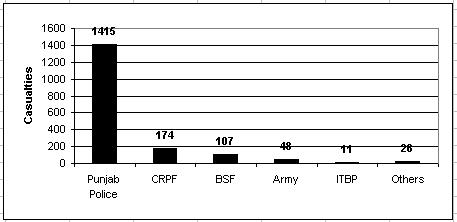
Fig.
1: Force Casualties in Punjab - 1981-96
The Punjab campaign, however, eventually
demonstrated not only that the civil police was an effective counter-terrorist
force even in the most extreme circumstances, but also that the presumption
of bad faith was completely unfounded. The role of the army and of para-military
forces was, of course, critical in the final phases of this campaign,
but it was the Punjab Police that spearheaded the anti-terrorist offensive
– and this is clearly borne out by the relative casualties these
various forces suffered [Fig. 1].
Both the devastating consequences of various "political
solutions" and of a resort to conventional military strategies
against terrorism are borne out startlingly by even a cursory review
of the pattern of conflict and response that prevailed in the initial
phases of the terrorist movement in Punjab. Counter-terrorist strategies
at this stage vacillated between the extremes of paralysis and over-reaction,
even as political responses and policies ranged from opportunism through
cynicism to panic. It was only towards the end of the Eighties that
mounting violence and a mix of exhaustion and alarm made at least some
political leaders and regimes – though certainly not all –
more amenable to a realistic appraisal of the threat and to the dictates
of reason.
It is not my intention to review this initial phase
in detail. Certain elements, however, demand elaboration, to the extent
that they define the context of the events and strategies that evolved
later.
Terrorism in Punjab has, on occasion, been projected
as a natural consequence of the unfulfilled collective aspirations of
the Sikhs, as "an idealistic movement for the creation of a state…
among the Sikhs of the Punjab".5 The
fact, however, is that the movement for Khalistan was created out of
a pattern of venal politics, of unscrupulous and bloody manipulation,
and a brazen jockeying for power that is too well documented to be repeated.
It will suffice to state here that each of the major political players
in the state and the national arena participated in the creation of
this calamity, and the Congress (I) and the Akali Dal were the most
culpable formations.6 This, indeed, was
the first stage where a pernicious pattern of political intervention
contributed, not to the resolution, but to the creation and nurturing
of terrorism.
Nor indeed, were any ‘Sikh aspirations’ involved
in the movement for Khalistan. Far from being a revolution against ‘oppression’,
this was actually a rebellion of a privileged quasi-feudal caste-based
orthodoxy that saw its privileges shrinking. It was, moreover, entirely
unconnected with any element or principle of Sikhism, and was based,
rather, on a corruption and perversion of everything that Sikhism has
historically represented. In it, "the institutions of the Sikhs,
both religious and political, …[were]… hijacked by a small
clique, a self-interested oligarchy, representing a particular ethnic
cluster, a small endogamous segment of Punjab’s social fabric;
a narrow caste group that…[sought]… to define Sikhism and
Sikh identity in terms of its own constricted vision."7
This convoluted pattern of politics, of competitive
communalism and brinkmanship in the Punjab, produced the larger than
life image of Jarnail Singh Bhindranwale. An image that owed its proportions
as much to the political leadership of that time as it did to the media
and, eventually and overwhelmingly, to his seizure and control of the
Golden Temple – the most hallowed shrine of the Sikhs. Whatever
the causes, it is a fact that, by 1984, Bhindranwale’s murderous
creed had captured the imagination of a significant number of Sikhs,
particularly in rural Punjab.
The years preceding 1984 are particularly inglorious
for the Punjab Police and its leadership. Their failure to act against
extremist elements was comprehensive. It was, nevertheless, understandable.
Before the 1980s, terrorism had only been experienced in India in regions
that were regarded as ‘peripheral’ to the ‘national mainstream’.
The North-East had long been troubled by bloody insurgencies, but was
generally viewed as an amorphous ‘disturbed area’ that invited
a certain pattern of armed intervention, primarily through use of military
force. Having served a quarter of a century in that region, I had seen
these campaigns at close quarters and had long regarded them as an inappropriate
model for intervention – one that reflected not only political
short-sightedness, but also a strategic failure of monumental proportions.
In Punjab, however, the shock of terrorist tactics – unfamiliar
in the extreme – produced a paralysis that was compounded enormously
by the conduct of politicians at the very highest level. To expect a
sagacious, balanced and adequate response from district police officials
against extremism that is clearly, directly, sometimes openly, encouraged
by leaders at the highest levels of governance, is to ask for the impossible.
In any event, in the absence of a clear mandate and a firm leadership,
the police, directionless and demoralised, quite simply, refused to
engage.
I was not present in Punjab at this juncture, but there
was ample evidence of this abdication of responsibility even when I
was transferred to the state in September 1984 – a full three months
after Operation Blue Star. I held joint charge as Inspector General
(IG) of the Punjab Armed Police (PAP) and IG Operations. In both capacities,
my jurisdiction comprehended counter-terrorist operations right across
the state, and I was astonished to discover that simply no records were
being maintained in connection with terrorist crimes, no investigations
were carried out, and almost invariably, no documentation existed of
any action taken. There was widespread reluctance on the part of Punjab
Police officers to involve themselves in anti-terrorist work. Many of
the interrogations had to be carried out by officers at a senior level,
as Station House Officers [SHOs] and subordinates at the police stations
were clearly unwilling to be associated with the process for fear of
identification and reprisals. As IG Operations, records relating to
terrorist crime and profiles of terrorists were essential to my work,
and it was only after this stage that a slow and painstaking process
of record-keeping and analysis was established.
Political mischief, a mounting campaign of demonstrations
and bandhs orchestrated to coincide with terrorist actions, increasing
and unpunished incidents of extremist violence, the evident impunity
with which terrorists acted, and the total uncertainty and apathy that
attended the actions of the law enforcement machinery, had, by 1984,
created an atmosphere of terror and collapse of the state that was far
in excess of anything that the situation itself warranted. Between 1981
and 1983, the terrorists had killed 101 civilians. Of these, 75 were
killed in 1983 itself [1981: 13; 1982: 13] – an event that, in
the prevailing state of hysteria, inspired one commentator to refer
to this as "The Year of the Armageddon";8
disturbing though the numbers were, this evaluation was more than excessive.
Indeed, even in the years preceding the advent of terrorism in Punjab,
the number of murders in the state were seldom below 500 in any year,
and tended to maintain a secular upward trend [1981: 555; 1982: 575;
1983: 591].9 More recently, in the three
years after terrorism was brought under control in Punjab there have
been a total of 2,081 murders unrelated to terrorism [1994: 687; 1995:
686; 1996: 708]. These numbers are not regarded as being extraordinary,
and have attracted no exceptional comment in the media, nor was there
any sense of a "breakdown" in the state.
Without doubt, the impact of terrorist killings –
as a result of their sheer brutality, irrationality and randomness –
is far greater on the public mind than that of an ordinary criminal
act. It is only natural for a poorly informed and sensation-hungry media
to devise frenzied headlines. But for the police administration to act
as if these represented an objective evaluation of the threat potential
is inexcusable.
But the police, no doubt stupefied by the sheer unfamiliarity
of the challenge, was also not permitted to act; nor did it dare to
act on its own against the manifest intent and stratagems of political
powers. The result was that, in the months preceding Operation Bluestar,
terrorist violence mounted to claim 158 civilian lives between January
and May 1984.
The sheer intensity of police paralysis at this time
has been substantially documented. Right since the Daheru incident in
1981, when an ill-prepared police party, when shot at by a group of
terrorists whom they had gone to arrest, abandoned its weapon and fled,
there had been acts of dereliction without number. Nevertheless, there
is one incident that bears repetition, as it reflects the abysmal depths
to which the spirits of the law enforcement agencies had plummeted.
A single incident epitomises their impotence. On
February 14, 1984, a group of militants attacked a police post at
some distance from the entrance of the [Golden] Temple. Six policemen,
fully armed, were ‘captured’ and dragged inside. The ‘police
response’ came twenty four hours later in the form of a senior
police officer who went to Bhindranwale in the Akal Takht and begged
him to release his men and return their weapons. Bhindranwale agreed
only to hand over the corpse of one of the policemen who had been
killed. He later relented and released the remaining five men who
were still alive. Their weapons, including three sten guns, and a
wireless set, were not returned. No one asked for them. No action
was ever taken in the case of the murdered policeman.10
I cannot imagine any police force in
the world reacting to such an outrage with such utter cravenness, in
such complete and impotent prostration.
Nevertheless, even under the prevailing
circumstances and with the victims of terrorism multiplying rapidly,
I cannot believe that what was done under Bluestar could be justified.
It is my firm conviction that with the right leadership and a clear
and unambiguous political mandate, the police morale could have been
revived [as it was, much later, and in a situation that was far worse]
to secure effective action; and that concerted police action, with suitable
para-military and army backing, would have produced better results even
at this stage. Instead, in an ill-planned, hasty, knee-jerk response,
the Army was called in: artillery battered the revered edifice of the
Golden Temple Complex, and tanks rolled across the holy parikrama.
The army, however, was not to blame for this botched operation; it was
acting on specific directions from the Prime Minister’s Office,
and had been given little choice or time to prepare.11
The damage Bluestar did was incalculable.
This was compounded by Operation Woodrose, the Army’s ‘mopping
up’ exercise all over Punjab that sought to capture Bhindranwale’s
surviving associates and to clear all Gurudwaras in the state
of extremist elements. Woodrose suffered from all the classical defects
of army intervention in civil strife – an extraneous and heavily
armed force suddenly transported into unfamiliar territory; mistrustful
(in this case, exceptionally so) of the local police and intelligence,
but with no independent sources of information; dealing with a population,
large segments of which had become hostile; and operating under a political
fiat that not only condoned, but emphasised the use of punitive force.
Operating blindly, the army arrested large numbers of people, many innocent,
others perhaps sympathetic to the militant cause, but by no means associated
with any terrorist or criminal activity. Lacking in adequate information
to distinguish effectively at the local level, the indiscriminate sweep
of Woodrose pushed many a young man across the border into the arms
of welcoming Pakistani handlers. And then, even as Woodrose drew to
an end, the evil was incalculably compounded by the pitiless massacre
of Sikhs in what were perceived to be Congress-I government-sponsored
riots of November 1984.
I regard Operation Bluestar and the
November 1984 massacres as "the two most significant victories
for the cause of ‘Khalistan’…not won by the militants,
but inflicted…. upon the nation by its own Government… These
two events, in combination, gave a new lease of life to a movement which
could easily have been contained in 1984 itself."12
After the army, it was the turn of the
‘political solution’. The Rajiv Gandhi government, having,
in its first days, remained a mute spectator to the anti-Sikh riots,
decided to force the ravaged state through a hasty and ill-timed election.
Negotiations were initiated by the central government in mid-1985. The
Akalis, led by Harchand Singh Longowal, assisted by S. S. Barnala and
Balwant Singh (of whom Longowal and Balwant Singh later fell to assasins),
showed great eagerness to reclaim their hold on events in the state.
But the Centre’s ‘strategy’ went well beyond the ‘moderates’
in the Akali Dal, and the government also initiated a dialogue with
representatives of the All India Sikh Students Federation (AISSF), at
that time a frontline terrorist grouping. I was asked, initially, to
be present at the meetings between the AISSF and the government’s
intermediaries, and subsequently, to intervene. Eventually, the AISSF
representatives expressed their willingness to join the electoral process,
but demanded a short deferment of the projected dates in order to prepare.
The Akalis who were negotiating separately with the government, however,
objected strongly, fearing that the AISSF, given this time, could sweep
the elections. The talks with the AISSF broke down on this trivial difference,
mainly because of the Centre’s inclination in favour of the Akalis.
The entire move to install the Akalis
in power was most unwise. It was based on an erroneous premise that,
just as the Marxists [Communist Party of India (Marxist) (CPI-M)] had
tackled Naxalism [CPI (Marxist-Lennist) terrorism] in West Bengal, the
Akalis would fight Sikh terrorism in Punjab. This was a complete misreading
of the relationship between the Akalis and the extremist. I was strongly
opposed to the elections of 1985, and repeatedly expressed my reservations,
because I was convinced that there was no real difference between the
fundamental thinking of the Akalis and the terrorists – and that
the Akalis completely lacked the desire and the will to contain terrorism.
I was equally convinced that terrorism would return with a vengeance
within six months of the Akalis forming the government – and events
soon demonstrated that even this projection was an overestimation.
The elections eventually took place
– but only after Longowal’s assassination – on August
20, 1985. Sympathy, and the lack of any serious opposition in the elections
on September 25 returned the Akali’s, now led by Barnala, with
a sweeping majority (73 out of 117 seats).
One of the first acts of the Barnala
government was the appointment of the Bains Committee which released,
en masse, over 2000 extremists at that time under detention.
The impact on terrorist violence was palpable – not only because
those who were released simply resumed their activities, but also because
others saw in this act a restoration of the immunity they had enjoyed
in the pre-Bluestar phase. 1985 had seen a total of 63 civilians and
eight policemen killed by militants. As the Bains committee began its
work, in just the first three months of 1986, 102 civilians and 10 security
men fell to the terror.
Barnala also surrendered the Golden
Temple to the terrorists once again. The shrine was restored to the
Akali controlled Shiromani Gurudwara Prabandhak Committee (SGPC) on
January 22, 1986. In less than a month, the terrorists, led by the Damdami
Taksal, were in complete control. The SGPC, in fact, had to shift the
venue of its Sarbat Khalsa (the general assembly of all Sikhs)
to Anandpur Sahib, because it was in no position to hold the event within
the Temple precincts. Once again, murderers swaggered across the parikrama;
proclaimed offenders, wanted by the police for the most heinous crimes,
planned and directed their activities from the security of the hallowed
complex; assassins installed themselves in the highest religious offices.
By the end of April, a ‘Panthic Committee’ had been
constituted to coordinate all terrorist activities, and a ‘Declaration
of Khalistan’ was issued by the Committee from the Golden Temple
(April 29, 1986). A day later, the Barnala government ordered a mock
search in the Temple with ample advance notice. It was an ill-conceived
and ill-planned raid (occasionally, if inappropriately, referred to
as ‘Black Thunder-I’) mounted by the National Security Guard
(NSG). The sum total of the impact of this Operation was the use of
stun grenades that resulted in the burning of a book shop near the gate
of the Temple, the beating up of two granthis after they had
been chased off the parikrama, and the interruption of an akhand
path due to the disturbances. Not unexpectedly, "no one of
note was caught"13 in this action.
The incident, however, was sufficient to provoke a split in the Akali
Dal, and, from that point onwards, Barnala’s existence was entirely
dependant on the Congress-I’s support. Nevertheless, after their
very brief ‘absence’ the terrorists simply returned to the
Temple and resumed control. The saga of complicity and cowardice that
abandoned the Temple and the state to the depredations of the terrorists
demands independent documentation. The simple fact, however, is that
during Barnala’s brief and feckless tenure of a little over 19
months, the lives of 783 civilians and 71 security men were sacrificed
in an ill-conceived political gambit that was predestined to failure.
The ‘political solution’ had
borne its bloody fruit.
But the harvest was to continue a great
deal longer. The violence escalated continuously as both the political
and the police leadership failed consistently to define an unambiguous
response to terrorism. Indeed, there was no concerted and consistent
bid to confront the problem squarely, no political strategy, and no
clarification of the principles of administrative, judicial and executive
response to the scourge.14 The police response,
to the extent that it was mandated by the political executive, was itself
muddled. Dictated by traditional notions of use of force in situations
of civil strife, the dominant thinking emphasised the ‘minimum
use of force’ against the unconstrained violence of the terrorists.
This thinking persisted among many police officers at the senior-most
level even after the introduction of the sophisticated Kalashnikov assault
rifle [the AK-47] into the terrorist armory after May 1987.15
With the supply of Kalashnikovs to the terrorists, Pakistan had clearly
increased the stakes of its covert war in India, and terrorism, at this
point, entered a completely new and deadlier phase. The impact was immediate
and dramatic. Explosives were yet to play a major part in the terrorist
strategy in the state. Though crude bombs extracted a steady toll of
innocent lives, it was only after 1990 that sophisticated explosives
became an essential component of the terrorist combat gear supplied
by Pakistan. The scale of killing, consequently, was directly connected
with the gun-power available to the terrorists – and did not recede
to the pre-1987 level until the terrorists were finally crushed towards
the end of 1992. Nevertheless, there was a comprehensive failure to
understand the magnitude of the shift the induction of this new weapon
represented. At that time, the police and para-military forces were
armed, in the main, with World War II vintage .303 rifles, or the equally
obsolete bolt-action 7.62s. The Central Reserve Police Force (CRPF)
were marginally better off, with 175 Self Loading Rifles [SLRs] per
battalion. But even the SLR was no match for the sheer lethality of
the Kalashnikov. With counter-terrorist operations under my charge,
I pressed urgently for an upgradation of weaponry at this point. A large
number of Light Machine Guns [LMGs], acquired in the pre-Independence
era, were lying unused in their original packing in the armories of
various police stations all over the state. My demand that they be deployed
in the war against terrorism was met with shrieks of horror from the
school of thought – comprehending a majority among the central
and state leadership, administrators and senior police officers –
that adhered to the dogma that a ‘civil’ police force could
not be equipped with ‘military’ hardware, irrespective of
the circumstances. This curious dogma, in the prevailing situation,
translated into the proposition that the police must remain inept, inefficient
and ineffectual, simply because they were a ‘civil’ force.
It was only after strong personal insistence on my part, and against
the prevailing wiqdom of those in authority, that these weapons were
eventually brought out and mounted on key police stations, as well as
on escort vehicles of Station House Officers (SHOs) and other frontline
police officers.
Even worse than the failure to come
to terms with the magnitude and nature of the terrorist challenge was
the inchoate and utterly confused philosophy of the ‘political
solution’ that still dominated even the thinking of the police
leadership. The then DGP openly expressed the belief that the police
could not wipe out terrorism, but was only in a position to "control
it".16
In the meanwhile, ‘political solutions’
remained very much in vogue even after the dismissal of the Barnala
government in May 1987. Earlier, with the appointment of Siddharth Shankar
Ray as Governor, and of Julio Ribeiro as DGP in early April 1986, the
Centre had begun to publicly advocate the ‘hardline’ against
the terrorists. By May 1986, moreover, while the lame duck Barnala government
continued to preside over Punjab, law and order was directly overseen
by the Centre and a policy of competitive brinkmanship between various
parties at the Centre and the state ensued. The Centre continued with
the two-faced tactics of attempting to strike ‘deals’ with
various factions of the militants, even as it sought to mount pressure
on them through police action. The selective immunity consequently granted
to some terrorist groupings, the shifting strategies of ‘negotiation’
opened out with various known extremists, including, prominently, the
‘Jodhpur detenues’ – surviving associates and supporters
of Jarnail Singh Bhindranwale who had been arrested during Operation
Bluestar – and a range of unprincipled political stratagem constantly
muddied the waters for the police.
Nevertheless, the police had begun to
commit itself for the first time in this long-drawn war – and the
conflict had certainly escalated to the level of warfare now. Between
May 1987 and April 1988 terrorists killed 1533 people in Punjab (a monthly
average of over 127), including 109 policemen. In turn, 364 terrorists
were also killed. But the vacillating and directionless policies of
the government, and the complete inability, indeed visible reluctance,
of the state to impose the rule of law – even in cases of the worst
acts of terrorism and where the perpetrators were apprehended by the
police – swelled the ranks of terrorist forces. Terrorism, which
had, in the past, largely been restricted to the districts of Amritsar
and Gurdaspur, now had another four districts – Hoshiarpur, Jalandhar,
Ludhiana and Faridkot – firmly in its clutches.
The government, however, persisted in
its opportunistic quest for just any kind of deal with the terrorists
to the very end. On March 4, 1988, 40 high profile prisoners –
the Jodhpur Detenues, including Jasbir Singh Rode – were released
as part of another compromise with terrorists. They simply walked into
the Golden Temple, where Rode was installed as the Jathedar (head
priest) of the Akal Takht [which was part of the deal]. Shortly thereafter,
the terrorists began to build up internal defences within the Temple
around the parikarma [which certainly was not].
The terrorist response to the Government’s
"goodwill gesture" was unequivocal. An unprecedented 288 people
– including 25 policemen – were killed in March and another
259 [including 25 policemen] in April.
With nothing left to trade, and 2866
lives [2207 civilians, 177 policemen, 482 terrorists] already sacrificed
at the altar of the false god of ‘political solutions between October
1985 and April 1988, the Centre decided that it was finally time to
enforce the laws of the land. This time, however, it was not the army
that was called in. Operation Black Thunder17
was executed squarely under the charge of the Punjab Police – backed
up by the elite anti-terrorist force, the National Security Guard [NSG]
and para-military forces. Its objective was identical to that of Operation
Bluestar – to clear the Golden Temple of the entrenched terrorist
forces. Unlike Bluestar, however, this was achieved in a clean, economical
and near-bloodless action, executed under the fullest glare of the media
– both national and international – within a week between
May 11 and May 18, 1988.
II
In the overall context of terrorism
in Punjab, Black Thunder was only a minor operation. Nevertheless, its
impact, in certain aspects, was critical. Though only a fraction of
the terrorists operating in the state were apprehended in the Temple,
it generated crucial structural transformations in the terrorist movement.
After Black Thunder, and the macabre exposures relating to the activities
of the extremists in the Temple, the movement for Khalistan could never
recover the facade of religiousity that had attended it in its early
years, and became increasingly and manifestly criminalised. Moreover,
the Gurudwara as sanctuary and safe-house for terrorists and
their leaders ceased to exist. It had been shown to be uniquely vulnerable
to a pattern of police action that would not agitate the devout, and
would inevitably force the renegade into police custody. The damage
done to the extremist cause was tremendous.
….the most significant…. was the loss of
the Golden Temple and the Gurudwaras as shield and sanction. Rape,
extortion and murder had been the business of the terrorists from
the very beginning of the movement; but in its initial phases, and
right up to the Black Thunder period, the top leadership was apparently
distanced from these activities, concentrated as they were in the
Golden Temple. Their depravity and vice in the hallowed place remained
unknown to the larger mass of Sikhs; and while lesser terrorists were
often seen to ‘stray from the path’, the highest motives
could still be ascribed to the militant leadership
Divested of the sanctuary of the Golden Temple and
the Gurudwaras, the leadership was forced to live life as fugitives
in the Punjab countryside; on the one hand, their own deeds exposed
them, and on the other, the deeds of their followers compromised them
even further, since they were now believed to be condoned, even encouraged,
by these leaders.18
I had assumed charge as Director General of Punjab
Police less than three weeks before Operation Black Thunder.19
After the successful execution of the Operation, I found, under my command,
a police force far from triumphant in this victory; deeply divided and
demoralised; ill-equipped, organisationally, materially and mentally,
to confront the larger challenge of eradicating terrorism from the entire
state. I had been serving in the state, but for a brief interregnum
(October 1985 – June 1986), since September 1984, in various capacities
that gave me state-wide jurisdiction, and I was more than familiar with
the difficulties encountered by the forces in Punjab. Specifically,
the problems that required immediate redress, and the steps taken to
tackle them – albeit gradually, and in a process that was often
frustrated by the lack of means and support from the political leadership
– included:
i. Inadequacy of the police stations to react
to terrorist violence on their own: The problem here involved manpower
and training, weapons, transport and communications. In most cases
of terrorist action, the local thana (police station) would
call for backup from headquarters or the para-military forces, and
no action would be taken till better equipped reinforcements arrived.
The inevitable delay rendered subsequent action more or less infructuous.
It was clearly necessary to minimize response time at the local level
by an enhancement of the thana’s capabilities. An across-the-board
upgradation of all police stations was, of course, financially unviable
and would have proven extremely wasteful. An exercise was carried
out to identify the police stations most affected by terrorist activity,
and to define the specific weaknesses of each of these. Many required
upgradation in terms of the officers in charge, and officers up to
the rank of Deputy Superintendent of Police were placed in charge
of some sensitive thanas instead of Sub-Inspectors. Then came the
question of the necessary wherewithal to confront the terrorist. With
the right person in charge, additional manpower and improvement in
working conditions, communications equipment, and mobility were the
next priorities. But none of these would be of any use without the
necessary firepower.
Shortly before Black Thunder, a decision had already
been taken to equip the CRPF with SLRs and Automatic Loading Rifles
(ALRs), and also to increase the number of holdings of LMGs, and the
weapons were airlifted from Delhi to Punjab in April itself. The effect
of this upgradation of weaponry was immediately visible in the increased
capabilities of this force to repulse terrorist attacks, and to confront
the militants on a relatively equal footing. Unfortunately, the Punjab
Police was still equipped with the old .303s. To the ex-tent that
I conceived of this force as the core of the anti-terrorist campaign,
this was clearly unacceptable. In 1987, as stated before, unused LMGs
lying at various police stations in Punjab had been brought out and
mounted on sensitive police stations, as well as on the escort vehicles
of the station house officers of various sensitive thanas.
The LMG, however, clumsy and heavy as it was, was hardly a suitable
counter to the AK-47; nor could a couple of LMGs in each police station
secure the necessary counter to the thousands of AK-47s then in circulation
with the terrorists.
Even after Black Thunder, it remained difficult to
convince the Centre on the urgent necessity of providing the Punjab
Police with better weaponry and other equipment. Shortly after taking
over as DGP, I had communicated my views on three critical areas of
weakness in this regard. The first related to the core problem of
upgrading each police station in terms of the specific challenges
it was required to confront, with graded improvements in force strength,
transport, communications and weaponry. The second problem arose with
regard to the protection of individuals who required special security.
Such protection was generally poor, and there were numerous cases
where people who were being protected were shot down along with their
security guards. The third problem related to the force’s limited
capabilities to carry out night operations.
Unfortunately, while limited ad hoc sanctions
were made for improvements in communications and transport, resistance
to improvements in weaponry persisted. However, some limited improvements
were engineered in other critical parameters. A phased recruitment
of an additional 25,000 men in the Punjab Police, took the total strength
up to 60,000. Limited facilities for housing for police personnel
in protected enclaves were created. And some improvements at the thana
level were initiated through devices that were largely dependant on
man-management and on squeezing the most out of the limited resources
available to the police. The objective of the entire exercise of reorganisation
and upgradation of the thanas was to make each police station
capable of reacting immediately and independently to any act of terrorist
violence in its jurisdiction, and this was, in substantial measure,
secured in all sensitive police stations within the year 1988 itself.
ii. Extremely unfavorable ratio of operational
to static and non-productive force in manpower utilisation: It is
a matter of unending amazement to me that when I took over, between
40 to 50 per cent of the 35,000-strong Punjab Police force was, on
any single day, tied down to static and entirely unproductive duties.
The bulk of this number was immobilized at innumerable nakas
(barricades) all over the state, particularly in the cities and at
checkpoints on the highways. These barricades, at best, helped create
the illusion of security among the general public through massive
and visible police presence; at worst, they provided terrorists with
easy targets for drive-by shootings, or for a ‘weapon-snatching’
raid. Even in my early days in Punjab, I had taken up the matter with
some of my colleagues, but to convince officers of the Punjab Police
that this was a waste of human resources was difficult. Even those
who were convinced said that it was impossible to dismantle and disband
the pickets, since the political leadership thought this to be the
best strategy for policing.
Nothing could be more wasteful of the available manpower.
If ever a terrorist was apprehended or shot in an encounter at these
barricades, it was only the result of inordinate stupidity on his
part. Not only was the concept of police pickets and barricades passive
and manpower intensive, it was completely cost ineffective and irrelevant
in terms of the results it secured. In the months following Black
Thunder a large proportion of the personnel trapped at these nakas
was rapidly reallocated to create an operational force that comprised
as much as 85 per cent of the total personnel available.
The reallocation of forces and infrastructure also
involved a number of innovations, one of them being the formation
of mobile-cum-naka contingents – essentially mobile units
which would move in terrorist areas to ensure significant police presence.
Another innovation, and one that created an enormous psychological
impact on the ground, was the concept of ‘focal point patrolling’
under which all available vehicles in the district were brought to
a single location, creating an impression of massive force and a level
of saturation and mobility that did not, in fact, exist. Meetings
were called by senior officers, at the levels of IG and the DG, late
in the night, and in the most sensitive areas; since all subordinate
officers in the district were required to be present at such a meeting,
many vehicles and a substantial force would cluster at these locations.
The impact of a significant, even though transient, mobile police
presence in areas which had previously seen little police action,
and at night, was enormous.
iii. Infiltration of the police by elements sympathetic
to the terrorist cause, and deep communal divisions within and between
various police and para-military units: Communal propaganda that was
rife in the state for the past many years had certainly had an impact
on the forces. The PAP had a fairly large number of sympathisers in
its ranks, as did sections of the Punjab Police. On the other hand,
the para-military forces, drawn as they were from outside the state,
and with only a small proportion of Sikhs in their ranks, tended to
display a strong anti-Sikh bias. These attitudes inevitably spilled
over into the general public, and the common man reacted on a purely
communal basis to the personnel of each of the security forces operating
in their areas. The inherent contradictions of the prevailing situation
led to a lot of suspicion and mounting tension between the Punjab
Police and contingents of the various para-military forces in the
state. Indeed, in June 1986, Punjab Police personnel had clashed openly
with the CRPF at Amritsar, and, at one point, it appeared that there
would be an exchange of fire.
There were two distinct elements in this problem:
the one, of course, involved individuals who had been swayed by the
sustained fundamentalist propaganda of the past decade; the other
was structural, involving the interaction, or, more accurately, the
lack of interaction between various security forces operating in the
state.
It was essential to segregate compromised elements
within the Punjab Police and PAP from anti-terrorist work, and to
reduce their involvement in sensitive duties. It was equally essential
to do this discreetly, in order not to exacerbate communal sentiments.
A continuous exercise was carried out to identify and allocate personnel,
whose loyalties were suspect, to duties that would not undermine anti-terrorist
operations. Another priority was to ensure that officers selected
to lead in various theatres of the low intensity war in Punjab were
free of communal bias, and acutely conscious of the dangers posed
by fundamentalist thinking to the social fabric of the state.
The structural conflict between various wings of
the security forces appeared to be a more complex problem, but yielded
to solutions that were fairly simple. During my charge as IG PAP &
Operations at Amritsar I had already initiated, at the local level,
a process of correction. The core of the problem was that the various
forces were acting in isolation from, often in competition with, each
other. There was no sharing of information, and deep-rooted suspicion
of the actions of the other units. The Punjab Police, moreover, was
extremely resentful of the presence of the CRPF, and over the fact
that it was the local force that was being painted as villains by
the general public. There was also the natural tendency for each force
to regard its own work as the most important. It was clearly necessary
for each force to know what the other was doing, and was clear about
its own and the other’s role. This was simply not happening.
For instance, even where the CRPF caught a terrorist and handed him
over to the PP for interrogation, the intelligence acquired through
questioning would not be shared with the CPPF. To counter this trend,
joint interrogation teams were created, and a system established to
share available intelligence between all forces engaged in the anti-terrorist
campaign. In Amritsar, moreover, a process had been initiated dovetailing
the operations of the Punjab Police and the CRPF. Over a period of
time, the two forces began to fight as one, achieving levels of coordination
and cooperation under fire that made their earlier hostility and suspicion
seem irrational, even unreal. These strategies were now extended with
similar salutary effect across the state, and one of the most important
components of this exercise was the induction of selected officers
from outside the Punjab Police cadre to take care of Operations at
all levels.
At one time, the IG Operations was from the CRPF
and was also looking after the Punjab Police, permitting greater coordination
of forces and a systematic re-organisation on the ground.
iv. Near-complete absence of systematic intelligence
gathering and analysis: Successful counter-terrorist strategies are
based on accurate and detailed intelligence on terrorist networks
and activities. It was only towards the end of 1984 that the framework
of something resembling an effective counter-terrorist intelligence
apparatus was set up in Punjab. As stated earlier, even the routine
practice of record keeping in connection with terrorist crime was
entirely neglected by the Police administration in the early years
of the terrorist movement. The skeletal structure of an intelligence
operation was created under my charge as IG Operations after September
1984. Officers were ‘borrowed’ from the para-military forces
and from the PAP, records relating to terrorist crimes were prepared,
and investigations started. After Black Thunder, intelligence operations
went much deeper. It was no longer adequate to carry out an analysis
of terrorist movements at the state level; what was required was details
at the ground level in each police jurisdiction – down to the
level of each police station in the main affected areas. Police stations
were first identified and categorised as A, B and C grade, on the
basis of the intensity of terrorist activities. Then a village-wise
analysis was carried out. Certain villages were seen to be much more
active in their support to terrorism, not only in terms of recruitment
to terrorist ranks, but also by way of giving shelter and providing
information and material assistance to the terrorists. Gradually,
unique patterns emerged from the surface uniformity of terrorist operations
across the state. Gangs and their main operatives were identified,
their strength determined, their primary, secondary and tertiary spheres
of operation defined, their relationships of cooperation and hostility
with other gangs documented. Detailed information was also gathered
on sources and flows of weapon supplies, networks of safe-houses,
harbourers and sympathisers, cross-border routes of ingress and egress,
and a large body of corroborated data based on surveillance operations,
informers, interrogations and the progressive infiltration of many
of the terrorist gangs. By early 1989 itself, a fairly clear, accurate
and continuously updated picture was available on the jurisdiction,
membership, activities, strategies and networks of each of the major
gangs operating in the state. A continuous system of documentation
and analysis, and of dissemination of all received intelligence was
also introduced shortly after my assumption of command as DGP, and
periodic intelligence reports were received by all senior officers
of the police and para-military forces in the state.
v. Absence of a coherent strategy of response
to terrorist activity: Successes in counter-terrorist operations prior
to 1988 were largely the result of extraordinary initiatives on the
part of individual and exceptional police officers. By and large,
the terrorists controlled the field, striking at will, and often simply
walking away from the scene of the crime. Occasional pursuit and engagement
by courageous security men produced occasional successes. Nothing
approximating a systematic and independent response strategy at the
state level could be identified.
On the basis of the enormous intelligence exercise
initiated after Operation Black Thunder, however, it became possible
to carry out operations that were area, gang and terrorist specific.
The initiative progressively passed out of the hands of the terrorists,
and into those of the security forces. No doubt, the terrorists retained
the capacity to organise unpredictable and entirely random strikes
against soft targets; six years after the defeat of terrorism in Punjab,
they still possess this capacity. What they lacked, however, was the
impunity of operations that they commanded in the past. Each major
strike by the terrorists was followed up with major counter-terrorist
operations. The responsible group was targeted not only in the Punjab,
but in their safe-houses all over the country. The detailed information
available of their possible escape routes – including shelters
with the extended families of each terrorist, extended families of
terrorists who had been killed in the past, key sympathisers and harbourers
– made it possible to mount surveillance and concerted pursuit
operations that, even where they did not result in immediate arrest,
paralysed individual terrorists and prominent groups, reducing their
capacity to act in future.
vi. The failure of police leadership: The police
was being ‘led from behind’. Senior officers sought to run
operations by remote control, minimising their own exposure to risk.
The result was that, while deployment of forces was worked out on
paper, there was little or no direct assessment at the senior level
to see that orders were implemented on the ground, and no accountability
for failures to check terrorist activities within their jurisdiction.
As the same attitude percolated down to the field level, even the
most routine police and security functions began to be totally neglected.
The low casualty figures among security force personnel and terrorists
in the pre-1988 phase tended to reflect, at least in part, a tacit
arrangement between a majority among the police and the militants
that they would not cross paths.
Two parallel elements constituted the strategy to
create an active and accountable police leadership. One involved a
radical policy of postings and promotion through which sensitive areas
and critical anti-terrorist operations were headed by officers (often
very young officers) who were willing to confront danger and take
strong personal initiatives, and most of whom volunteered for these
high-risk assignments. A number of courageous officers from other
state cadres and from the para-military forces were also brought in
at crucial positions, while those whose motivation, loyalty or bravery
was suspect simply ‘opted out’ for softer postings, often
on deputation outside strife-torn Punjab.
But even the finest men cannot be asked to risk their
lives for a leader who will not lead from the front. Deeply conscious
of the honour and responsibility of commanding these men in a crucial
war for the nation’s unity and integrity, I made it my practice
to move constantly across the state, in areas worst affected by terrorism.
I had been touring the state continuously as IG Operations & (PAP)
(September 1985 – October 1986) and as ADG Law & Order (June
1987 – April 1988), directing and appraising anti-terrorist operations
– and the response had been most encouraging. These tours constituted
a pre-dominant part of my routine throughout the anti-terrorist campaigns
in the state, with, on the average, more than twenty-five days of
each month spent on the road, journeying again and again, deep into
the terrorist heartland.
The combined impact of these measures was enormous
and immediate. At one stage, there appeared to be a general consensus
– in the media, the public, the political leadership, and even
among police officers – that the police were demoralised, cowardly
and incompetent to face the challenge of terrorism. I soon found that
their ‘demoralisation’ was, in reality, only the absence of
clear directives from above; their ‘cowardice’ was only confusion
caused by conflicting commands, administrative sanctions and political
pressures; and their ‘ineptitude’ reflected only the absence
of a coherent strategy and a clear mandate for action.
People in Punjab’s villages spoke of a situation
where the police refused to move out of their barricaded police stations
after dark; the force’s will to fight terrorism, it appeared,
had been completely broken.
The appearances were deceptive. What had been lacking
was a clear mandate, and a freedom to carry on the battle without
crippling political interference. Throughout the era of the ascendancy
of terror, virtually every hard-core terrorist had a political patron;
police responses were distorted to such an extent that effective reaction
was precluded even in cases where policemen and their families had
been specifically targeted by the terrorists. But the will was far
from lacking.
Within five years, this very force was to spearhead
one of the most dramatic victories in the history of world terrorism.
The men who were said to have been cowering in their police stations
chased the terrorists deep into their own territory; and chased them
to their deaths.20
These five years, however, saw many reverses, a great
deal of perverse, pernicious political meddling, and enormous sacrifice
by nameless, faceless and now forgotten jawans and officers of
the forces that fought the terror.
In the days following Black Thunder, the terrorists
ravaged Punjab. 343 civilians were slaughtered in May alone. They included
30 migrant labourers working on the Sutlej-Yamuna canal in Ropar district;
another 45 migrant workers gunned down in Punjab and Himachal Pradesh;
and 20 killed in a bomb blast outside a temple in Amritsar. These reprisal
killings were a demonstration that Black Thunder had not decimated their
numbers in significant measure, nor undermined their capacity to strike
at will.
But the police made demonstrations of its own. The
swift redeployment and reorientation of forces bore immediate results,
and the civilian casualty rate fell rapidly. The first six months of
1988 had seen 1266 civilians killed, yielding a monthly average of 211
casualties; in the second half of 1988, 688 civilians were killed –
a high figure, but nevertheless a radical improvement – with the
monthly average down to 114. The terrorists, moreover, began paying
a heavy price. On July 12, ‘General’ Labh Singh, the head
of the Khalistan Commando Force (KCF), at that time one of the most
active terrorist gangs, died in an exchange of fire with the police.
Avtar Singh Brahma, another dreaded terrorist, was among the 68 terrorists
killed that month.
By January 1989, the terrorists had been pushed into
a thin strip along the border, with over 70 per cent of their strikes
restricted to just three of the twelve districts in Punjab – Gurdaspur,
Amritsar and Ferozepur. This proportion was to remain a constant throughout
1989 and well into 1990.
It was only natural to focus attention on this area.
In March 1989 a massive composite Special Operation – bringing
together the forces of the Punjab Police, the CRPF and the Border Security
Force (BSF) – was launched in the entire Mand area (a patch of
marshland primarily lying in the Amritsar and Ferozepur districts, but
flowing over into Kapurthala and Jalandhar as well), Ajnala, Jandiala,
Tarn Taran and Batala (along the river Beas). In a single month, 5280
villages and 8859 farm houses/behaks/deras were covered
in cordon-and-search combing operations. These special operations became
a regu- lar feature in the terrorist heartland, yielding a steady stream
of arrests and seizures of arms, ammunition and explosives, and mounting
pressures on the extremists that they found it progressively harder
to bear. The impact was compounded by highly focused intelligence-based
operations, as well as by the effective use of ‘spotters’
– captured terrorists who helped identify former associates. By
May 1989, the anti-terrorist drive had completely blunted the capabilities
of leading terrorist groups to strike at soft targets. The organisations
that that had been reduced to a negligible presence included the Khalistan
Liberation Organisation (KLO), the Bhindranwale Tiger Force of Khalistan
(BTFK) and the Babbar Khalsa, the last of which had perhaps the most
dedicated and resourceful, and the most dreaded, cadres.
Security operations, however, were not the only problem
the terrorists had. Black Thunder had already revealed that a majority
of recruits to the terrorist cause were found among common criminals.
Their exclusive motivation was crude profit, or the supplementary fruits
of the illegal power militancy conferred: access to women, to status
within the village, and, at the lower levels, to the minor perquisites
of the ‘trade’ – a motorcycle, dry fruits, liquor –
essential components of the idea of the ‘good life’ in rural
Punjab. Inevitably, the movement became highly criminalised and alienated
from even those segments of the general population that may, in the
past, have supported them. The top terrorist leadership – the two
‘Panthic Committees’, one that was eventually headed by Dr.
Sohan Singh [Panthic Committee (SS)], and the other dominated by Gurbachan
Singh Manochahal and Wassan Singh Zaffarwal [Panthic Committee (M)]
– was by now based entirely in Pakistan. Both groups were well
aware of these developments. Nevertehless, beyond making various ‘statements’
to cadres in India (as evidenced by ‘Press Notes’ and by correspondence
recovered from terrorists who were arrested or killed), and issuing
exaggerated threats of reprisal against those who were ‘defaming’
the movement through acts of extortion, rape and the murder of innocents,
they chose to do nothing. Their own power, and profits depended on these
criminal activities, and they were themselves too deeply compromised
for these statements to be taken as anything other than propaganda,
and they had simply no impact on the ground.
These were not the only signs of trouble in the rag-tag
armies of ‘Khalistan’. Violent turf wars broke out between
various gangs. There was, of course, already a deep and basic difference
at the highest level of leadership, divided as it was between two irreconcilable
‘Panthic Committees’ (a third ‘Panthic Committee’,
propped up by the Damdami Taksal, was also to emerge later, in September
1989). Pakistani handlers had made repeated attempts to mediate in order
to bring about some sort of rapprochement between these groupings, but
were entirely unsuccessful. The differences were hardly ‘ideological’;
indeed, neither group – or for that matter, no individual or grouping
in the movement for ‘Khalistan’ – was in a position to
project anything that could pass off as a coherent ideology. The disagreements
were largely a result of the bloody history of conflicts between the
various protégés of each Panthic Committee. Equally significant
was the distinctive constitution and strategy of these groups: The Panthic
Committee (SS) drew its cadres from a relatively educated urban/semi-urban
class, and executed operations primarily against marked targets (though
there were innumerable exceptions in which the general public was victim
to their violence). The Panthic Committee (M), on the other hand, drew
its support from rural Punjab and was dominated by the illiterate and
semi-literate; by and large, their ‘strategy’ was to create
as much chaos as was possible through completely indiscriminate killings.
With their emphasis on ‘soft targets’, groupings allied to
the Panthic Committee (M) were responsible for a preponderance of the
major terrorist actions in the 1988 and 1989 period, although its major
striking arm, the BTFK, had suffered enormous losses by mid-1989.
All this, however, was at a plane well above the murk
and depravity that marked the daily dealings of terrorist groups. Here,
the hard currencies of exchange were control over the narcotics trade
and gun-running; disputes did not arise out of ideologies, religious
principles, or tactical disagreements; personal ambition and greed were
the motives in ascendancy.
These factors helped the security forces tremendously,
as traditionally sympathetic sections of the population in Punjab grew
progressively disillusioned with the terrorists. The disillusionment
extended to the rank and file of the terrorists as well, many of whom
had visited Pakistan and seen the decadence and corruption of their
‘Chief Generals’, and others who saw the outright criminality
of their immediate leadership within Punjab.
The terror in the state had, till this point, been
absolute. Public cooperation with the police was meagre, and even in
the case of orchestrated public executions by small terrorist gangs,
there was virtually no protest or resistance from the people at large.
But all this began to change towards the middle of 1989. Since at least
some of the police weaponry had been upgraded after Black Thunder, there
were a substantial number of discarded .303 rifles available in police
armouries. A Village Defence Scheme (VDS), and a system of appointing
Special Police Officers (SPOs) was devised. The objective was to arm
volunteers in vulnerable villages to resist terrorist action at the
local level. The scheme was far from an immediate success. When I visited
a village in Jalandhar District after a number of killings there, I
called the village elders and suggested that the police could arm volunteers
so that they would not be as susceptible to sudden terrorist raids in
future. The response was outright refusal. The villagers were afraid
that the terrorists would selectively target the armed villagers, or
even the entire village, if any sign of resistance was shown. Nevertheless,
repeated visits over the following months and persistent efforts by
senior officers eventually bore fruit, and some villages responded positively.
Volunteers were trained in weapon-handling, and a number of gun license
holders were also involved; detailed tactical plans were drawn up for
the defence of each village; bunkers were built; initially, small police
contingents were also provided at night to buttress the local initiative.
SPOs, often army or police veterans, were placed in charge of each village
operation. A great deal of effort was expended to ensure that an effective
apparatus of self-protection was created, and that the scheme did not
degenerate into a cosmetic exercise in morale building. By April 1989
itself, 2350 weapons had been distributed in 451 villages, and the VDS
was to play a significant role to the very end of the war against terrorism.
There were other signs, small but nonetheless significant,
of the turning tide. On June 6, a bus was hijacked by terrorists near
village Talwandi Ghowan, PS Kathunangal, in the Majitha Police District,
Amritsar. The Hindu passengers were forced off the bus and were about
to be executed, when two Sikhs, Avtar Singh and Rajwant Singh, intervened
to save their lives. They were shot dead, and two other passengers were
seriously injured. The incident generated a great deal of revulsion
against the terrorists among Sikhs in Punjab. Then again, just a month
later (July 7), when a terrorist opened indiscriminate fire in the Tarn
Taran bazaar, he was over-powered and beaten to death by the shopkeepers
– an event virtually unimaginable even a few months earlier in
this heartland of the terrorist movement.
The combined impact of the pressure exerted by security
forces and the slow but definitive changes in the public response provoked
a panic among the leadership in Pakistan and their Pakistani handlers.
In March, Manochahal sent written instructions to his followers directing
them, among other things, to make hideouts in other states because of
the pressures in Punjab; he also instructed his top leaders to go underground
to avoid any further killings, as it was becoming increasingly difficult
to get new recruits. In April, another letter followed up with instructions
to create hideouts in Delhi and in far-away Bidar in Karnataka; a key
operative, Satnam Singh ‘Chinna’ was ordered to remain underground,
lest he was killed. Wassan Singh Zaffarwal similarly issued warnings
against the infiltration of government agents in his gangs and urged
his ‘Generals’ to step up falling recruitment. By May, militants
were being advised to use new routes to smuggle weapons across the border.
Jammu & Kashmir, Rajasthan and Gujarat were identified, and major
recoveries of weapons intended for Punjab were shortly to be made in
Rajasthan. By July, moreover, a number of hard-core and listed terrorists
had moved out of the Punjab and set up operations in the Terai region
of Uttar Pradesh, not as a measure to expand their areas of operation,
but to escape the increasing pressures in Punjab.
The pressure also forced a change in tactics and weaponry.
Militants in Punjab were advised to increasingly resort to the more
surreptitious device of the timed or remote controlled plastique explosive
device rather than the AK-47, which required them to be present at the
moment of execution. Explosive handling became an integral part of training
in the camps across the border after April, and some of the first significant
seizures of plastique explosives and sophisticated IEDS and timing devices
were made in May. (See Fig. 2).
The flood of weapons in the state also assumed new
and disturbing proportions. Till this point, weapons acquisition had
to be financed by the terrorists themselves through extortion and narcotics
smuggling. Suddenly, in July, messages were sent out that weapons "which
had accumulated in Pakistan for which no payment is to be made"
could be acquired by the simple expedient of sending "large numbers"
of terrorists across the border.
Since the beginning of the year, the terrorists had
mounted a sustained propaganda campaign to pressurise SPOs, Punjab Home
Guards [PHGs] and policemen from rural Punjab to resign their jobs on
pain of death, and to stop participating in the campaign against militancy
in the state. In March alone, some 60 Home Guards surrendered their
arms and left their jobs. A steady trickle of such desertions was to
continue in the months to follow. What was amazing, however, was that
despite a mounting campaign of targeted killings against them, the number
remained insignificant. This remained true even after September when
the campaign was extended to organised attacks on the members of the
families of policemen – despite mounting losses, the force gave
no quarter.
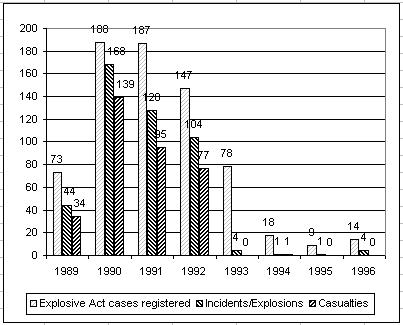
Fig 2: Trends in terrorist acts involving explosives in Punjab
The augmentation of the terrorist arsenal
led to a substantial escalation of terrorist activities. But civilian
casualties were held firmly down throughout 1989, even as the losses
inflicted on the terrorists, and by them on the police, mounted. Pakistan
was strenuously and openly directing the terrorist campaign at this
stage, to the extent that terrorist training camps were being organised
even within 75 metres of the international border (in the Ferozepur
sector). Border crossings re-mained a continuous and daily occurrence
along the 533 kilometre long international border Punjab shared with
Pakistan, and could never really be effectively checked, despite 122
kilometres of fencing that had been erected by August 1989.
However, exhaustion, the impact of a
continuous depletion in their ranks, declining trends in recruitment
and critical casualties among their leaders had taken their toll. Inspite
of every effort on the part of their Pakistani patrons, the morale of
all the terrorist groupings active in the state had taken a beating.
Tentative feelers were now being sent out. One by one, all the major
terrorist factions approached me for a face-saving solution. They wanted
to negotiate surrenders – and were willing to do so on their knees,
as long as they were not publicly humiliated, and as long as they could
escape the extreme penalties their actions over the past years would
attract under the normal course of justice.
Their various proposals were routed
by me to Delhi.
In the meanwhile, the campaign continued.
By the end of the third quarter of 1989, a fairly high rate of civilian,
terrorist and police casualties notwithstanding, the militants had been
pushed inexorably into a corner. Almost 76 per cent of all terrorist
incidents in 1989 were contained within four police districts along
the border (out of a total of 15 police districts in the state):21
Majitha, Tarn Taran, Batala and Ferozepur. More significantly, of the
fifteen police districts in the state, 10 were only marginally affected
by terrorist activities, with several months in the year passing without
a single killing there. At the end of the year, four of these districts
had an average civilian casualty rate of less than two a month;
in another six districts, casualties ranged between 2-5 a month. It
was only in the four ‘core districts’ that the average rate
ran into the double digits.
Even within these districts, the terrorists’
sway was not absolute. By the 4th quarter of 1989, just 13 police stations
accounted for nearly 65 per cent of all terrorist crime [and 64 per
cent of civilian casualties] in these critical districts. And out of
the 217 police stations in the entire state, nearly half the killings
had taken place within the jurisdiction of just these 13 police stations.22
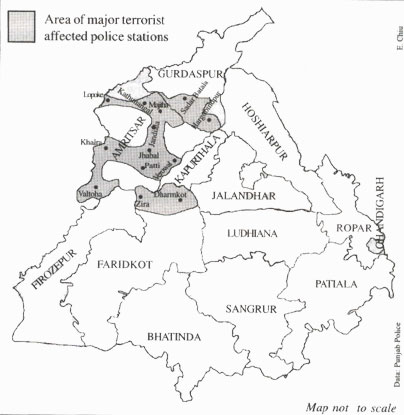
Fig 3: Major terrorist Affected Areas in the 4th Quarter of 1989
I was then, and still remain, absolutely
convinced that terrorism, at this juncture, could have been wiped
out in the state of Punjab within another six months of sustained
campaigning.
III
Politics, however, was destined to
intervene once again. At a time when the militants were imploring
the government for a general amnesty with greater passion and urgency
than had ever attended their demands for Khalistan, the Centre refused
to respond. A general election was now imminent, and a deeply discredited
regime, swamped under charges of corruption and nepotism, sought to
play on popular insecurities. Terrorism became the critical issue
of its election campaign – the Congress-I alone, it proclaimed,
could defend India against the menace of militancy. At this juncture
it appears that the party leadership believed it could profit by allowing
the sore to fester a little longer. Once it returned to power, of
course, the Punjab problem would be sorted out soon enough.
The moment passed. Soon it became
amply evident that the Congress-I would not return to power at the
Centre. The offers of conciliation petered out as the militants decided
to bide their time.
The announcement of elections itself
had a destabilising impact in Punjab. Unmindful of the critical juncture
at which the anti-terrorist campaign stood, and the inherently unstable
character of the equation that had been established, the Rajiv Gandhi
government decided to press ahead for elections in the parliamentary
constituencies in this state as well.
The All India Sikh Students Federation
had, by now, decided to complement its underground activities with
an over-ground role. It combined with Simranjit Singh Mann’s
pro-militant United Akali Dal [UAD], and the extremist front organisations
swept the poll, with 10 of the 13 seats going to candidates backed
by the alliance. Before demitting office, Rajiv Gandhi ordered the
release of Simranjit Singh Mann, and of Harminder Singh Sandhu and
Atindar Pal Singh of the AISSF. All cases against them were arbitrarily
dropped to give ex-pression to what was then, perhaps, a proposition
unique to Indian justice administration, that a man elected to Parliament
may not be tried for any crime that he may have committed.
The war against terror, as with all
wars, is fought as much in the minds of men as it is on the field
of battle. The V P Singh government that took oath of office on December
6, 1989, brought with it preconceptions, attitudes and a pervasive
confusion that surrendered the initiative to the terrorists even before
they engaged.
The defining incident with regard
to this Government’s policy on terrorism occurred within the
first week of its installation. The daughter of the newly appointed
Home Minister was kidnapped in Kashmir (on December 11, 1989) by what
was then an incipient terrorist movement in that state. The government’s
response was absolute capitulation – and, within days, Kashmir
simply exploded into a full-blown insurgency that is still to be brought
under contrml.
The message to extremists all over
the country was abundantly clear: this government had neither the
will nor the understanding to define and implement a cogent and resolute
policy against terrorist violence.
V P Singh’s policy orientation
to terrorism in Punjab was, in all its simplicity, comprehended by
the expression frequently used by him: ‘healing hearts’
he believed, was all that was needed. Two of his most prominent advisors,
ethnic Punjabis, but completely alienated from the peculiar politics
of the state and inconceivably ignorant of the nature and magnitude
of the terrorist threat, were quite convinced – and apparently
succeeded in convincing their Prime Minister – that terrorism
had long been kept on an artificial respirator by the Rajiv Gandhi
regime. With the election of the Janata Dal government, it would simply
‘wither away’. All that was required was a little symbolism,
a few sympathetic, sentimental gestures, and the violence, the terror,
would melt away.
The first gesture came a day after
the swearing in, when V P Singh visited the Golden Temple. This was
followed by a public meeting at Ludhiana on January 11. No concrete
strategy, approach or plan for the resolution of the state’s
problems was defined either on these occasions, or later. The government
simply embarked on a policy of prevarication and drift reflecting
an abject failure of political understanding and will.
While the government dithered, terrorist-affiliated
overground organisations initiated an unprecedented secessionist campaign
that was to reverse all the gains of the preceding years. For over
five years (since Bhindranwale’s death) the movement had been
divested of a public voice, speaking only the language of the bullet
and the bomb. Even those among the people of Punjab who may have been
sympathetic to the extremist cause had only two possible roles to
play – either to take up the gun themselves, or to harbour and
support those who did – and in each, they were pushed well beyond
the pale of the law.
But now elected Members of Parliament
spoke openly of ‘Khalistan’. Harminder Singh Sandhu, immediately
after his release, had declared that Khalistan was the exclusive goal
of the AISSF, and that his organisation would talk to the new V P
Singh government "only through the aegis of the United Nations".23
By January, Mann had also declared that there was no question of holding
talks with the Centre. Soon, he was talking of a plebiscite or referendum
to be held under UN supervision to determine the status of the Sikh
people.
A closely coordinated and aggressive
agitational programme was simultaneously launched in collaboration
with escalating terrorist activities. A document recovered after a
BSF encounter on February 17, containing a 13-point directive from
Wassan Singh Zaffarwal to Mann revealed the essence of this strategy.
The operative part of the directive was that while the common goal
was unquestionably Khalistan, morchas could be launched to
achieve other limited objectives, such as getting the Sikhs registered
as a separate qaum (nation) under the Indian Constitution,
or pressing for the implementation of the Anandpur Sahib resolution,
or other specific goals that would help systematically further the
cause.
The ‘Federation’ (the UAD-AISSF
combine) now launched an enormous public campaign, backed by high
levels of coercive mobilisation, that was to create numberless problems
for the police and security forces. Calls for bandhs became
a daily occurrence; jathas were sent to court arrest and gherao
police stations after every police action or arrest of a terrorist.
But that was not all. New events were created from day to day –
bhog (commemorative prayer) ceremonies for every terrorist
killed by the police; numberless anniversaries, shaheedi samagams,
of ‘martyrs’; foundation-laying and inaugural rites for
commemorative gates, nishan sahibs and gurudwaras constructed
or to be constructed in honour of felled extremists – memorials
that had, in the past, never been erected except in the names of the
greatest saints of Sikhsim. Each of these events became an occasion
for the most inflammatory rhetoric, as political and religious leaders
addressed the people in the most immoderate terms possible, constructing
a false mythology of sacrifice and martyrdom around the death of every
common criminal whose reign of terror, extortion and purposeless violence
was brought to an abrupt end in an encounter with the security forces.
Progressively, moreover, the Gurudwaras in the villages of Punjab
– while they could not recover their status as safe-havens for
the terrorists – lent themselves to the dissemination of subversive
and violently communal propaganda.
It was from these religious and quasi-religious
platforms that the new spokesmen for Khalistan began to justify the
unjustifiable. Precisely how far they went can be estimated from a
statement Mann issued after 13 Bihari migrant labourers – who
had no conceivable connec-tion with or interest in the ongoing strife
– were gunned down by terrorists at Zira in Ferozepur on May
27, 1990. The killings were condoned by Mann on the grounds that the
‘Bhaiyyas’24 in the
CRPF were ‘committing excesses’ on the Sikhs in Punjab and
were also responsible for excesses committed under Operation Blue
Star.
This incendiary mix of politics, religion
and intimidation culminated in a campaign of disruption that pinned
down ever-increasing numbers of security personnel, progressively
reducing the force available for operational duties. Police stations
and senior police officials were gheraod; roads and railway
tracks were blockaded; bandhs and strikes paralysed life in
urban areas. It was not long before calls for such action emanated
– not from their ‘front organisations’ – but from
the terrorists themselves, and were enforced through threats of ‘dire
consequences’ that were widely advertised through press notes
(dutifully published by the Press), posters and the public address
systems of Gurudwaras. After a point, when a terrorist was killed,
the people of the area to which he belonged were simply and routinely
directed to observe a ‘protest bandh’ in the advertisements
for his bhog ceremony itself.
The mobilisation of massive crowds
for these orchestrated events was a masterful exercise, entirely independent
of the popular will. Village sarpanches were simply directed
to bring a specified number to the tractors-trolleys and trucks that
were ‘requisitioned’ to take the crowds to the day’s
gherao or bhog. The public address system of the village
gurudwara made announcements at night, directing the villagers
to report at the appointed hour, with the unequivocal rider that disobedience
would be met with dire consequences. Hundreds of trucks25
and tractor trolleys carried the captive protestors from one demonstration
to another, day after day, throughout this period. Threats were also
widely circulated before every protest bandh in urban areas.
The messages were clear, and compliance, total.
This, of course, is not to say that
popular support was totally absent at this stage of the movement.
Indeed, such support grew continuously as the mix of religion and
politics, the rhetoric of the bhog ceremonies and the shahidi
samagams, touched a sympathetic chord among simple rural folk.
This strategy of quasi-political mobilisation
was backed up by a massive and well coordinated campaign by another
group of terrorist front-organisations masquerading as human rights
activists. ‘Fact finding committees’ comprising sympathisers
or pro-militant politicians were set up after each police operation.26
At a time when an average of over 200 people were being killed in
a month by the terrorists, these ‘human rights’ activists
pretended that every action by the security forces was unjustified.
Every terrorist was killed in a ‘false encounter’ (there
was no such thing as a ‘genuine encounter’ in their lexicon,
the words ‘false’ and ‘encounter’ went together
by definition). Every arrest victimised the innocent. Every action
by the security forces was an ‘excess’, an ‘atrocity’.
The countryside was rife with stories of these alleged ‘police
atrocities’; but in every case, they were ‘known’ to
have happened in ‘a village nearby’, to have been witnessed
by a person invariably other than the narrator; they transpired in
an indeterminate area of the mind that could not be identified on
any map of Punjab, but which existed, at once, everywhere and nowhere.
It was an extraordinary and highly
successful campaign. And one that could not, for a single moment,
be dissociated from the wave of increasingly focused violence that
now began to spill out of the border districts into the space created
by the over-ground political activities of the pro-militant groups.
This enlargement of the sphere of terrorist activities resulted in
a thinner spread of the security forces on the ground. The disruption
these tactics caused was far greater than anything the terrorists
had, or could have, achieved in the past. Moreover, with the increasing
over-ground activities of militant groupings,
there was a progressive blurring of lines between the legitimate and
the illegitimate. Terrorists openly attended meetings and gatherings
called by the UAD and AISSF leaders; and if the police intervened,
loud protestations of ‘police harassment’ were made at the
highest levels.
For the police, these were harrowing
times. Large numbers were withdrawn from operational duties to cope
with the daily campaign of disruption. These demonstrations became
effective and highly impenetrable covers for the movement of terrorists
and their arsenal, since the police could not engage with a sprinkling
of extremists within large gatherings of common citizens, making their
task even more difficult. Worse still, The terrorists now directed
a virulent and intensifying campaign of intimidation and murder against
the security forces, especially in the lower ranks. The objective
was to provoke mass desertions, and the strategy was implemented in
a highly systematic manner. Initially, a number of intelligence operations
were set up by the militants, gathering information on police personnel
and their families. Thereafter, threats were issued that, if these
personnel did not ‘resign’, they and their families would
be liquidated. The threats were backed by a rising graph of killings
of police personnel and their families. The year 1990 alone saw 506
policemen killed – a majority of them while they were at home
on leave. 19 members of their families were also killed by the terrorists
– a number that was to rise sharply to 134 in 1991, as the terrorists
made the families of policemen their favoured soft target in a concerted
bid to demoralise the force.
The targeting of police families was
the most unsettling of terrorist strategies. Soldiers all over the
world risk their lives – but they do so in the security that
their loved ones, their parents, their wives, their children, are
secure from violence, and that their own actions are in defence of
the welfare of their families and community. This is the case, not
only in conventional warfare, but also in traditional low intensity
conflicts and counter-terrorist campaigns where the army or para-military
forces are inducted from regions and communities outside the area
of strife. In Punjab, however, the police, the SPOs and the PHG Volunteers
were all drawn from the state itself, and predominantly from the very
areas worst affected by terrorism. Their actions, their participation
in counter-terrorist operations, indeed, the very act of wearing a
uniform, exposed their families to unbearable risks, and subjected
these men to tensions and pressures that fighting forces are ordinarily
not required to confront.
And yet, they did not succumb in any
significant measure. With 60,000 men in the Punjab police, another
15,000 PHG volunteers and more than 10,000 men mobilised under the
VDS and SPO schemes, barely 600 had abandoned their posts by the end
of 1990, a majority among them from the relatively poorly equipped
PHG and SPOs. Only a handful of desertions took place in the police,
primarily among newly recruited constables.
This is all the more remarkable in
view of the State’s equivocal posture regarding counter-terrorist
operations in this phase, the increasing criticism of police actions
by ‘human rights’ bodies, the media, and even by government
agencies and officials, and the extraordinary inducements the terrorists
offered for cooperation. Terrorist organisations, at this point, were
making fresh recruitments at salaries between Rs. 3000 and Rs. 5000
per month, with a range of perquisites, including huge compensations
to families in the event of death, superior weapons and sweeping powers
of life and death in their areas of control. The temptation to cross
the line must have been overwhelming, especially at a time when (towards
late 1990 and through 1991) the victory of the militants was widely
believed, both among the people and the more weak-kneed among the
political leadership and administration, to be ‘inevitable’.
The morchas, the dharnas,
the bandhs, the ‘human rights’ propagandists, the
targeted and escalating terrorist violence – all these could
have been tackled without difficulty, were it not for the policy of
confusion – or perhaps more correctly, the completely absence
of any coherent policy – pursued by the government. V P Singh’s
Prime Ministership was not marked by any significant initiatives in
Punjab after the first flourish of symbolism. Instead, the mounting
tide of violence and open political subversion was compounded by irrational
and arbitrary force withdrawals. When his government was sworn in,
there were 288 companies of para-military forces in Punjab, well below
the estimated optimal allocation of 306 companies plus 36 companies
required for special operations. In March, with an explosive situation
emerging in Kashmir, and unmindful of the increasing chaos in Punjab,
this number was brought down to 274 companies; out of these, a further
27 companies were allocated under a special contingency plan to the
Army, leaving just 247 companies for operations in Punjab. The companies
allocated to the Army were gradually released by September, restoring
para-military force levels at 274 companies. But several further ‘adjustments’
were necessitated by the Babari Masjid crisis in Ayodhya, and it was
only in November that the force levels stabilised at 283 companies.
The bogey of Assembly Elections in
the state was, moreover, kept constantly alive throughout this phase,
perpetuating an element of political uncertainty and constant political
jockeying between both the over-ground and underground militant groupings.
It was only in September, with the extension of President’s rule,
that the question was briefly settled, only to be reopened shortly
after by the Chandrashekhar government.
Meanwhile, the scope of political
activity among parties and organisations of (relatively) moderate
propensities had been completely eliminated. On May 14, the terrorists
made an attempt to kill Gurcharan
Singh Tohra, the SGPC President –
and a ‘moderate’ Akali only if the definition was stretched
to its very limits – on the Ludhiana-Patiala highway near village
Pahwa. Tohra, an ex-MLA, H S Rajia and a gunman were injured, while
the driver of the vehicle died on the spot. Rajia succumbed to his
injuries in hospital. Less than a month later, Balwant Singh, an ex-Finance
Minister of the state, was gunned down in Chandigarh. The traditional
Akali parties simply went into hibernation, and no other national
or regional party had, at this juncture, a functional state wing in
Punjab.
In any event, the V P Singh government
collapsed under the weight of its own internal contradictions after
eleven brief and inglorious months of ceaseless crises, including
the nationwide conflagration over the Mandal Commission and reservations
for backward castes that it conjured virtually out of the dustbin
of the government’s archives.
The new Prime Minister, Chandrashekhar,
heading a minority government with outside support from Rajiv Gandhi’s
Congress-I, was to preside over another mockery of governance for
a further seven months. In Punjab, he took over virtually where V
P Singh had left off, broadcasting his willingess to "talk to
anyone", including the terrorists.27
The Prime Minister’s offer of
talks was greeted with predictable contempt. Manochahal, voicing what
was then the general view held by the militants, issued a ‘statement’
that any such talks could only be about Khalistan, and would have
to be held in Geneva. Wassan Singh Zaffarwal declared that the only
issue that was to be negotiated was the proposed boundaries between
India and Khalistan. These sentiments were echoed faithfully by the
‘human rights’ lobby, including General Narinder Singh of
the Punjab Human Rights Organisation (PHRO), who asserted that no
talks for anything less than Khalistan could be held with the Government.
The terrorists, in any event, knew
that the government was trying to negotiate on its knees. With its
own survival in question from day to day, it had nothing substantive
to offer. Moreover, the militants had enormously strengthened their
position in Punjab. Only the incurably deluded could possibly believe
that they would give away anything as long as they thought they were
in a position of control. The spiral of violence had to be broken
before any space could be created for a constructive political initiative.
Unfortunately, the political arena
at that time appeared to be dominated by the simple-minded or, perhaps,
the simply reckless. I was asked to make arrangements for talks with
representatives of prominent militant groups. This was done –
though I saw fit to warn the Prime Minister that none of them could
be trusted to adhere to any commitments they might make in exchange
of specific concessions from the government. On the very first meeting,
among the first demands to be raised was for my removal from Punjab.
The Prime Minister capitulated, and I was transferred to Delhi on
December 18, 1990.
I was not privy to any of the discussions
the Prime Minister had with the militants. The inescapable fact, however,
is that these ‘negotiations’ had absolutely no impact on
the ground. If anything, terrorist violence escalated.
The army had been inducted into the
state in November itself in what was called Operation Rakshak I. Plans
for the Operation had been detailed much earlier, but after my removal
from the state, their eventual execution did not follow the structure
of inter-force command and co-ordination that I had envisaged. The
result was that Operation Rakshak-I followed the pattern of conventional
Army interventions in internal disturbances, certainly exerting substantial
pressure on militancy in the border districts – where the bulk
of deployment had occurred – but failing
to alter the course of militancy in any significant measure. In fact,
what Operation Rakshak-I did was to partially squeeze militancy out
of the border districts and into virtually the entire state (these
trends are discussed in greater detail below).
The Chandrashekhar Government played
out its final gamble in Punjab when it forced the state to join the
rest of the nation in the mid-term elections slated for June 1991
(though the elections were to be staggered in such a fashion as to
allow Punjab to go to the polls well after the process had been completed
in the rest of the country). In April, the government announced that
elections to the parliamentary and state Assembly constituencies in
Punjab would be held simultaneously. The terrorist groupings split
down the middle, with those broadly owing allegiance to the Damdami
Taksal deciding to participate, and the second group affiliated to
the Panthic Committee (SS) deciding in favour of enforcing a boycott.
A large number of the 2146 candidates
who filed nominations for the Assembly and Lok Sabha elections were
overtly or covertly supported by terrorist organisations. By the time
the nominations closed, in any event, even the groups officially boycotting
the elections had hedged their bets by surreptitiously putting up
candidates. 211 of the candidates had clear terrorist links, and 34
were at that time behind bars. 41 candidates had ‘history sheets’
(police records) that enumerated offenses including political assassination,
hijacking and murder; another 48 were relatives of prominent listed
terrorists.
Many of the candidates had refused
police protection, declaring that they would make their own arrangements
for ‘security’. They now began to move openly around the
state with large groups of illegally armed terrorists as their ‘bodyguards’.
In the meanwhile, the Panthic Committee (SS) let loose a campaign
of liquidation that was eventually to claim the lives of 27 candidates.
On June 7, an explosion damaged the cavalcade of the Minister of State
for Home at Gill Road in
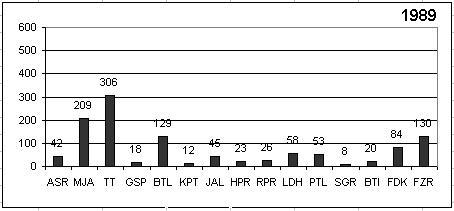
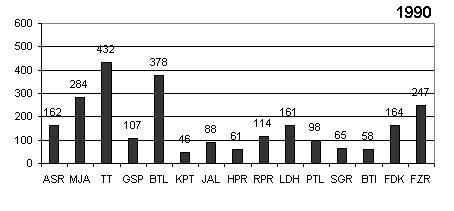
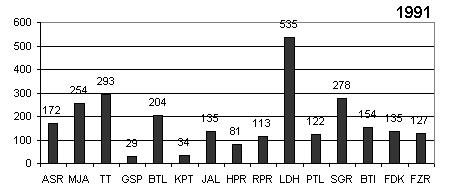
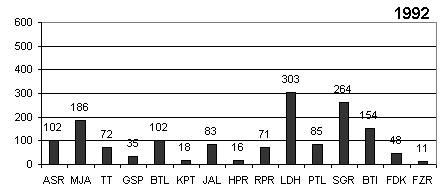
Note: The number of police districts
in Punjab was increased to 20 over the period 1990-93. However, all
data has been aggregated over the 15 'original' jurisdictions that
existed in 1989 to allow for continuity and comparision.
Fig 4: District-wise trends in
civilian casualties
Ludhiana (the MoS was contesting the
Ludhiana Parliamentary seat). On June 15, 74 train passengers were massacred.
Yet, the ill-planned and unconscionable gambit for elections in Punjab
was not abandoned. It was only after Narasimha Rao was sworn in as Prime
Minister of June 21 that this unseasonable elections was eventually
aborted.
The irrationality of the decisions inflicted
by the Chandrashekhar regime on Punjab persisted to the very end. Despite
the enveloping mayhem in the state, the Army had, inexplicably, been
withdrawn from the state by this time, and para-military force levels
had been cut drastically.
It was during the General Elections
of 1991 that Rajiv Gandhi was assassinated. The Congress-I rode back
to power on a wave of sympathy, and Narasimha Rao was sworn in as Prime
Minister. But the chaos created by the preceding 18 months, during which
the declared policy of two successive and singularly incompetent governments
was ‘winning the hearts and minds of the people’, could hardly
be contained by an electoral victory at the Centre. The years 1990 and
1991 unambiguously belonged to the terrorists.
Almost as many civilians were killed
by terrorists in these two years, as in the preceding 12 – the
entire span of the terrorist movement in Punjab. Between 1978 and 1989,
there were 5070 civilian casualties; in 1990 and 1991, they were 5058.
The area of conflict now covered the
entire state. After Black Thunder, terrorist crime had been confined
mainly to the border districts. But by the end of 1991, the ‘terrorist
heartland’ had extended itself from 13 police stations in four
border districts [64.6% of terrorist crime in the 4th quarter of 1989]
to over 47 police stations that now accounted for 61% of the greatly
enhanced terrorist crime in a widely dispersed area. Only four of the
15 police districts registered a monthly average of civilian casualties
below 10. This was easily cancelled out by another four, where civilian
casualties were in excess of 20 per month. In Ludhiana, this figure
stood at over 44 per month. [See Fig 4]
While the levels of terrorist violence
in the border districts remained high, the command centre of terrorist
operations shifted gradually to the Malwa region, with Ludhiana and
Sangrur as its core. The greater dispersal of terrorist activities was,
in substantial measure, intensified by Operation Rakshak-I which exerted
a great deal of pressure in the border areas. In the absence of a co-ordinated
policy of containment, the top terrorists were gradually ‘squeezed
out’ into the Malwa and Doaba belt. Four border police districts
(Tarn Taran, Majitha, Batala and Ferozepur) accounted for 878 killings
by terrorists in 1991, as compared to 774 in 1989; this, however, represented
a significant decline as against the 1341 civilian casualties inflicted
in these districts in 1990. But 1991 also saw 535 civilian killings
in Ludhiana (1989: 58; 1990:161), 278 in Sangrur (1989:8; 1990:65),
and a total of 2591in the state (1989: 1168; 1990:2467). Distress migrations,
which had come down to a mere trickle of ones and twos in a month in
1989, rose to 2524 families through 1990 and 1991 (averaging over 105
families per month).
Viewed in isolation, these figures may
suggest that the police and had, once again, withdrawn into a defensive
shell in the face of this widening arc of terror. This was far from
the truth. Indeed, it was a paradox of the Punjab situation at that
time that, while the police (both state and central forces) engaged
continually, and while terrorist casualties rose constantly, the killings
of civilians also registered sustained and alarming increases.
This was largely due to the renewed
successes in terrorist recruitment, which had virtually come to an end
in 1989. At that time, the strength of listed and unlisted terrorists
was estimated at no more than 1,200. By the middle of 1990, this number
had risen upwards of 5,000, and rose above this level throughout 1991,
despite the continuous and escalating losses suffered by militant groups.
In 1989, under a relatively stable political dispensation, 703 terrorists
had been killed, and militancy appeared to have been on the verge of
total defeat. In 1990, 1320 terrorists lost their lives, in 1991, another
2177 fell under the ‘benign’ dispensations of two ‘hearts
and minds’ regimes – and yet, the terrorist movement grew
from strength to strength.
While Pakistan had put her whole might
behind the Punjab terrorists, the response of the Indian government
was marked by indecision, an abject lack of political will, and a yawning
policy vacuum. All institutions of the state were in full and open flight;
only two forces were operative: the terrorists and the security apparatus,
with every other wing of governance paralysed.
There were severe onslaughts on the
morale of the security forces by the militants and their over-ground
sympathisers. A sustained agitational and propaganda campaign was backed
by narrowly targeted terrorist violence. Close relatives of police personnel
were kidnapped, intimidated and liquidated, even as police casualties
mounted. Worse still, criticism of the police came not only from the
media – which had capitulated completely before the ‘Panthic
Code’ that had been enforced by the militants, and that was accepted
by the official media, AIR and Doordarshan, as unquestioningly as by
the national and regional newspapers (with a single isolated exception)28
– but from the government as well, on occasion finding its source
in the Prime Minister’s office itself. For the rank and file, fighting
the nation’s war at grave personal risk and with enormous losses,
there was not a single source of encouragement or succour beyond their
own officers. The forces, nonetheless, fought on doggedly, valiantly,
and in complete isolation.
There is one final aspect of this phase
that requires attention. At this time, the claim that militancy in the
state somehow represented the inchoate popular aspirations of the people
– specifically of the Sikhs – had acquired substantial force
through the over-ground campaign organised by sympathisers. But it was,
overwhelmingly, the Sikhs themselves who were the victims of terrorism
(See Fig. 5). Moreover, and this is critical, it was the Sikhs –
in far larger numbers than ever comprised the terrorist armies –
that stood against the movement for Khalistan. 65% of the Punjab police,
of course, were Sikhs. But more significantly, there was increasing
and organised resistance among civilians against terrorist violence.
What had been an occasional instance of individual courage and initiative
throughout the Eighties now replicated itself in numberless acts of
heroism and sacrifice that challenged the tyranny of the militants.
A single index of this swelling popular resistance is the success of
the VDC and SPO schemes – initiatives that found few takers in
1989, but which had assumed enormous significance between 1990 and 1991.
There were 1075 village defence committees and some 596 SPO pickets
functional in the state by the end of 1990, accounting for more than
15,000 volunteers. Despite the overwhelming and highly focused militant
assault against them, and the peculiar vulnerabilities of these voluntary
forces, the VDCs and SPOs stood their ground even at the end of 1991.
The total desertions over these two traumatic years – including
VDCs, SPOs, PHGs and the Punjab Police – numbered barely 600.
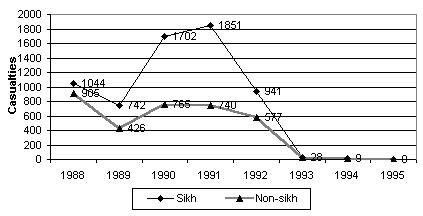
Fig 5: Sikh & non-Sikh Casualties
inflicted by Terrorists
But the people of Punjab were betrayed
by their political leadership and by the Government. The one truth that
stands out above all others during this phase is that a confused, irresponsible
and ill-informed government that follows a policy of conciliation, even
capitulation, in the face of terrorism is the cruelest affliction that
a troubled people can be called upon to endure.
IV
When the Narasimha Rao Government took
over at Delhi, the terrorists were on a roll in Punjab. Their successes
over the past eighteen months had spawned dozens of new militant groups
and revived many others that had long been defunct. Their armies had
grown five-fold. Large masses of the people gathered on their every
command. A multiplicity of ‘Panthic Committees’ claiming to
represent the collective will of the ‘Sikh people’, issued
grand proclamations on all subjects – codes of conduct, treatises
on morality and ‘religious’ duties, decrees against the Government
and its agencies, stern warnings to the faithless and recalcitrant;
they directed punitive strikes and murderous displays of force against
those who failed to show due deference to their arbitrary will. True,
more of their ranks were being killed; but ever more stood ready to
step into the breach. There was an air of absolute certainty, of consummate
confidence, that their ‘war’ against the Indian State was
in its terminal stages, that their goal, ‘Khalistan’, was
imminent. ‘Governments in exile’ appointed themselves in America
and the UK; ‘Prime Ministers’ and ‘Presidents’ of
‘Khalistan’ waited in the wings for the impending victory.
Brutal turf wars between terrorist groupings grew in number and intensity,
keeping pace with the sweep and power of their actions against the people
of Punjab and the security forces, as their final
goal appeared tantalizingly within reach.
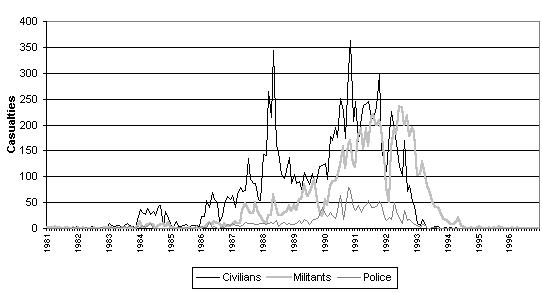 Fig 6: Civilians, Police and Terrorist casualties
in Punjab - 1981-1996
Fig 6: Civilians, Police and Terrorist casualties
in Punjab - 1981-1996
For those who were not there –
in the middle of the turmoil, witness and victims to the slaughter,
confounded by, or resisting, the swelling enormity of the terror –
it is difficult to recall or imagine how close the situation was to
complete disintegration.
Nevertheless, the degree to which this
anarchy had fed upon the regime of political license, of submission
and appeasement of the preceding dispensations became clear as soon
as an unequivocal policy was enunciated and implemented on the ground.
When Rao took over as Prime Minister,
the very possibility of ‘political solutions’ in the Punjab
had ceased to exist. The various Akali factions, including those openly
sympathetic to the militant cause, had been completely marginalised
during the aborted elections of June 1991, when the terrorists decided
they would rather ‘represent’ themselves. Simranjit Singh
Mann had himself been forced out of that election, though many militant
nominees were to contest under the cover of his faction, the UAD (Mann).
The other main political leader of the militant cause, Harminder Singh
Sandhu of the AISSF, was long dead by this time, murdered by terrorists
of the Khalistan Commando Force (KCF), an affiliate of Sohan Singh’s
Panthic Committee, in January 1990. The ‘traditional’ Akali
parties had, of course, withdrawn into a shell of compliant self-preservation.
In any event, with the numerous and continually multiplying factions
of political and terrorist groupings in the state, there was no identifiable
‘leadership’ with whom a dialogue could be initiated, even
if the inclination had existed. The terrorists themselves, of course,
had no reason to negotiate at this point, convinced as they were that
they were poised on the very edge of victory.
An escalation of terrorist violence,
at this stage, was inevitable. June itself had
seen 245 civilians and 54 security men killed. July, August and September
cost another 659 civilian and 123 security men. In October, the violence
peaked, with 297 civilian and 53 police casualties. The political compulsions
of the Rao Government made a response inevitable, with mounting pressure
exerted on the Centre by the Punjab state units of the Congress-I and
the Communist Party of India.
In November 1991, the Centre finally
took action. The army was re-inducted in Punjab and the forces were
given an unambiguous mandate – order had to be restored in the
state, and grounds prepared for the election that fell due in mid-February,
when the existing Parliamentary sanction for President’s rule came
to an end. Despite my strong personal objections, I was transferred
back to the State as DGP shortly thereafter.29
But the elections, this time, were not
an enterprise in political adventurism, not a gamble, not a retreat
of responsible governance in the face of lawlessness, but an integral
element of a coherent strategy for the restoration of Constitutional
governance in a state where all its institutions had, for close to a
decade, been paralysed or rendered impotent. They were based on a clear
recognition that democratic institutions and processes were meaningless
in a situation of enveloping terror, and that peace was a precondition
– and not a necessary consequence – of the exercise of popular
franchise.
This recognition was translated, in
its first expression, into the provision of adequate force in the state,
backed by an uncompromising policy of non-interference. Law and order
was entrusted to the professional agencies of the state within whose
constitutional mandate they fell. There was no back-seat driving from
Delhi, no dubious political moves and manoeuvres, no deals with terrorists
and their over-ground agencies, undermining strategic and security initiatives.
The Government vested a certain, clearly defined, responsibility on
the security forces; and the forces did not fail the nation.
What emerged now, was one of the most
unique experiments in multi-force counter-terrorist strategic initiatives
and integrated command structures.30 Unlike
previous operations, the army and the police (both state and para-military)
acted in complete concert, with a clearly defined institutional structure
of cooperation and consultation. An officer of the rank of Inspector
General (IG) from the Punjab Police was attached to each Corps of the
Army deployed in Punjab. A Superintendent of Police (SP) was assigned
to each Brigade. Police contingents were attached to every Army battalion,
so that comprehensive and coordinated actions could be taken independently
by each unit in all emerging circumstances. There was total sharing
of all intelligence, to the extent that police control rooms had representatives
of the Army present, so that relevant intelligence was passed on a continuous
basis to every concerned unit. This interaction was carried right up
to the highest level, and I personally coordinated actions with each
Corps Commander at Ambala, Bhatinda and Jalandhar. It is a measure of
the commitment of the officers of every force involved in this phase
of the war against terrorism that no considerations of sub-group loyalty
were permitted to undermine the integrity of operations; the entire
idea of ‘competitive command’ – where various agencies
vie with each other for ‘victories’ – which inevitably
characterised joint operations in the past, was simply dispensed with,
and a new structure of ‘cooperative command’ emerged. Throughout
this final phase of counter-terrorist operations in Punjab, the entire
period during which the army was present in the state under Operation
Rakshak-II, I do not recall a single occasion on which this system of
cooperative command was compromised by personality clashes or by force
loyalties.
The pattern of Army deployment during
the run-up to the elections was also significantly
innovative. Traditionally, Army commanders have preferred massive presence
in specific sensitive locations. During this phase and right through
the election period, however, the Army was deployed all over the state;
more importantly, it was split up to section level in order to saturate
the entire countryside.
Adequate force was also provided for
the protection of candidates in the forthcoming elections – a total
of 220 para-military companies. An entire platoon was assigned for each
candidate’s security: a section deployed at the candidate’s
residence, another as personal escort, and a third that preceded the
candidate as an advance party to each scheduled meetings. Once again,
the objective was clearly defined – the disorders and selective
killings that resulted in the cancellation of the elections of June
1991 were not to be allowed to be repeated. Despite the commitment of
such a large force to these security duties, patrolling also had to
be intensified; nevertheless, counter-terrorist operations were still
sustained across the state.
The impact on the ground was immediate.
In November itself, the number of civilians killed by terrorists fell
to 154. Of these, 110 were killed in the first fortnight; the second
fortnight, when the Central Government’s initiatives were implemented
in Punjab, saw just 44 civilian casualties. A number of major terrorist
groupings immediately decided to protect their top echelons by advising
them to shift outside the state, or even out of India, or to go into
a temporary hibernation during which they were instructed to tone up
their internal structure and improve operational capabilities.
The elections of February 1992 also
forced the militant camp into innumerable strategic failures. The most
monumental of these was the decision to impose a boycott on the elections.
Goaded by their foreign mentors, as well as by their funding and support
groups among non-resident Sikhs in USA, Canada and UK, the terrorists
began to believe that if they could force another
postponement on the elections, or, failing this, keep voting percentages
down below 10 per cent, they would discredit India’s democratic
credentials. If few voters exercised their right of franchise, they
were led to believe, they would be able to convince the international
community that this amounted to a ‘referendum in favour of Khalistan’.
Of all the prominent militant leaders and ‘ideologues’, the
only one to oppose this move for a boycott was – surprisingly,
since he was the strongest advocate of a boycott in June 1991 –
Sohan Singh; but his position drew such violent opposition even from
his own supporters that he was forced to temporarily flee his safe haven
in Pakistan.
Unlike the boycott of June 1991, moreover,
there was also eventual unanimity in the militant camp that no Akali
faction would be permitted to participate in the elections of February
1992. (Only a single, utterly unknown, faction of the Akali Dal, led
by Kabul Singh, eventually participated in the elections).These objectives
were secured by a campaign of intimidation. The entire state was saturated
with posters, handbills, leaflets, press notes, statements and paid
advertisements in selected newspapers, as well as by direct threats
to candidates, voters and election officials, warning of reprisals against
any act of cooperation with, or participation in, the election process.
A ‘total curfew’ on pain of death was announced by the militants
for February 18 and 19 to discourage voting. On February 8, three teachers
assigned to election duties were gunned down, and another six were put
to death on February 10. In order to terrorise urban voters, 18 explosions
were engineered between February 5 and February 19, and attacks against
political campaigners claimed 16 lives before the elections. In a final
‘warning’, 13 spinning mill workers were massacred at Barnala
on the night of 17/18 February.
Nevertheless, not a single candidate
standing for this election was killed. The election itself passed peacefully,
except for one incident
in which a grenade was thrown on a Congress-I
election office in Ludhiana, killing one person, and injuring twelve.
The voter turn-out was low, no doubt.
But it installed an elected government with a comfortable majority in
the state. Most importantly, it was a functional government – not
a puppet regime. From this point onwards, law and order – and,
naturally, counter-terrorist policy – was firmly within the sphere
of the state government’s responsibilities (unlike the Rajiv Gandhi-Barnala
arrangement of 1985-86). For the first time, an extended period of political
stability, and planning with at least a five-year perspective, became
manifestly possible.
The essence of the state government’s
policy on terrorism under Chief Minister Beant Singh was an extension
of the principles implemented by the Centre in the preceding months.
The institutions of Constitutional democracy and governance were to
be progressively revived, and to this end, the reign of terror was to
be brought to an end. Counter-terrorist operations would not be undermined
through any negotiations, pacts or bargains with terrorist groups; nor
would the political executive interfere with legitimate police operations,
investigations and actions. In my entire tenure under this government,
I recall only one instance in which a political ‘recommendation’
was routed to me; it was in connection with a case of murder, and I
wrote on the file that when politics began to intervene in a murder
investigation, that would be the end of law and order in the state.
There was no subsequent attempt at interference in the duties and responsibilities
vested in the police.
The greatest impact of the 1992 elections
was that they, once again, banished the terrorists – indeed, the
entire movement for ‘Khalistan’ – into the netherworld
of an unambiguously criminal identity as the mask of politics was ripped
away. Their over-ground political organisations stood comprehensively
discredited in the eyes of the people by this time – essentially
as a result of the militants’ own stand against them.
Had the terrorists themselves – or through their nominees –
participated in the elections, they may still have enjoyed the substantial
immunities that come with a legitimate political position, and would
have been able to participate in a range of over-ground activities which
could tie down the security forces – as they had done in the past
– and help blur the lines between their criminal and political
identities. Now, however, they had entirely forfeited their political
voice, and could speak only through the bullet and the bomb – a
language that the security forces were well equipped to contend with.
They realised their blunder soon enough.
In a desperate damage control exercise, they sought to re-activate the
traditional Akali factions to initiate programmes of mass agitation.
A militant-inflicted ‘unification’ under the banner of the
Shiromani Panthic Action Committee (SPAC) sought to bring all over-ground
pro-militant and Akali factions on a single platform. The people were
exhorted to boycott the Members of the newly elected Legislative Assembly,
to prevent the entry of ministers and MLAs in their villages, and to
not approach any minister in connection with personal grievances or
any other work. The people, frustrated with the many years that they
had suffered without redress, ignored their calls; the elected representatives,
voting percentages notwithstanding, began to serve precisely the functions
that they are intended to in a democratic framework. Within weeks of
the election, the supposed mass base of the movement for ‘Khalistan’
had vanished without a trace.
But the violence persisted. In the days
following the elections, 24 voters were killed in separate acts of reprisal
in Sangrur, Bhatinda, Ropar, Jalandhar and Ludhiana. In March, the terrorists
adopted a new strategy of massive strikes in urban industrial complexes.
On March 10, terrorists gunned down 15 executives of a private company
in Sangrur. In two strikes at Ludhiana, on March 14 and 18, the terrorists
killed 34 industrial workers. On March 21, a similar operation in Ahmedgarh
killed 14.
Each shift in terrorist strategy was
immediately countered. In the post election period, the army no longer
maintained the saturation levels that it had sustained through the elections.
The troops, while still deployed in the state, were returned to barracks,
and called out only for specific operations – especially to provide
rapid-response teams to back up police action, and to provide the outer
cordon in search operations. The responsibility for dealing with the
new pattern of terrorist actions, consequently, fell squarely on the
police. There were some 140 to 150 urban centres in Punjab. Senior officers
who were pushing files at Police Headquarters in Chandigarh were mobilised
to confront the new challenge, and each of them was assigned four to
five such centres. Each centre was divided into sectors along a grid,
and vehicles and manpower were allocated for patrolling and pursuit
duties along strategic points. With this single device, the threat to
urban industrial concentrations was contained.
In April, the terrorists shifted attention
to targeted killings of security personnel. The first quarter of the
year had seen 54 security men killed. In April alone, the terrorists
killed 51 and injured another 73. By August this strategy was to be
extended to the most intensive campaign against the police and their
families. When Sukhdev Singh Babbar, chief of the Babbar Khalsa International
(BKI) – by this time the most powerful terrorist grouping in the
state – was killed in an encounter with the police on August 9,
63 family members of policemen were killed in retaliation – forty
eight of them between August 9 and 11 itself. In addition, 37 policemen
also lost their lives, bringing up the total of these targeted killings
to 100 out of the 167 persons killed in the state in that month.
In addition to the police, the terrorists
were also targeting political leaders and government officials. There
was a car bomb attack on one state minister at Amritsar in May. The
son of another minister, and the brother of a third were killed. The
most gruesome among this series of targeted actions
was the kidnap and subsequent murder of M L Manchanda, the station director
of All India Radio at Patiala, on May 27. Manchanda’s torso was
found in Patiala and his head in Ambala.
The response came in the form of three
strategies. The first of these was based on the immediate identification
of the perpetrators of the latest outrage, and the application of the
fullest force to secure their arrest or elimination.31
The Manchanda killing is a case in point. The Babbar Khalsa had immediately
claimed the killing, in order to impose the militant ‘code of conduct’
on the government’s broadcast agencies. Gurdial Singh Babbar, one
of the perpetrators of this outrage, was pursued and killed in an encounter
on the same day (May 27), and Amrik Singh Kauli Babbar, who master-minded
the kidnapping and killing, met the same fate on June 2.
The second strategy focused on the most
important terrorists. An analysis of terrorist strikes had shown, curiously
in view of the increasing scope and range of terrorist activities in
the state over the past two years, that inspite of their improved striking
capacity and mobility, militancy in a majority of cases was highly localised.
Even the most important terrorist leaders were found to operate within
a radius of no more than 15 to 20 kilometres from their respective villages.
With this knowledge, and with continuous intelligence from a variety
of forces, it became possible to immobilise, and eventually arrest or
eliminate these elements. Consequently, instead of wasting resources
on every petty criminal and opportunist who had joined the terrorist
ranks, the available manpower and infrastructure was focused disproportionately
on the leaders, the planners and the ideologues of the movement. Among
the 139 hardcore terrorists who fell to this strategy in 1992 were a
dozen self-styled ‘Chiefs’ and some 20 ‘Deputy Chiefs’
of various terrorist groups, including Rashpal Singh Chhandran, the
Chief of the BTFK (June 12), Gurjant Singh
Budhsinghwala (July 29), Chief of the
KLF, and Sukhdev Singh Babbar, Mukh Sewadar of the BKI (August 10).
(One of the last major successes for the security forces was to come
in January 1993, with the death of Gurcbachan Singh Manochahal, Chief
of the Panthic Committee (M) and the BTFK (M) in an encounter with security
forces at Village Rataul in Tarn Taran.)
The third element of the strategic response
came, in the wake of the August killings of policemen and their families,
in the shape of Operation Night Dominance. Once again, an analysis of
the pattern of terrorists activities indicated that an overwhelming
majority of the killings in the villages took place in the late evening
or very early morning. All senior officers were directed to take personal
charge of operations at night. From this point on, these officers would
be leading night-ops three or four days in every week – and
performing their normal duties during the day.
The collective impact of these initiatives
was clearly evident by the time the year 1992 came to a close. The situation
was so vastly different as compared to the chaos that prevailed at the
end of the previous year, that it was possible to speak of a total reversal
against the terrorists. The total number of civilians killed in the
state in 1992 stood at 1518, as compared to 2591 in 1991, reflecting
a fall from a monthly average of 216 to 127. This, however, was not
all. The lowest figures in 1991, in the months of November and December,
stood at 154 and 126. In 1992, if the year was split into two halves,
the monthly average fell to 87 in the second half. In the last quarter,
this average stood at 60. In December itself, the total civilian casualties
stood at 44. They were never to rise to these levels again. Indeed,
in the whole of 1993, civilian casualties totaled just 48.
This was not all. A complete transformation
had taken place at the psychological level among the people. After the
elections of February 1992, the terrorists had failed entirely to elicit
any demonstration of support or cooperation from the people of the state.
Bandh calls, bhog ceremonies and other directives emanating
from terrorist quarters evoked no response from the public.
The coercion and intimidation that had
resulted in the low voter turnout in the elections of February 1992
were also exposed when elections to 95 Municipal Committees in the state
concluded peacefully on September 6, with a voter turnout of over 75
per cent. These trends were endorsed when Panchayat Elections were held
in the state’s 12,342 villages in January 1993, with a voter turnout
of 82 per cent. The termination of the Village Panchayats, and their
replacement by Khalsa Panchayats had been one of the critical objectives
of the terrorist movement.
The transformation went far beyond the
return of grassroot democracy and a refusal to cooperate with the militants,
to comprehend an enveloping sense of relief. A state that had, for at
least the preceding seven years, simply shut down before the sun set,
was rediscovering the experiences of peace and normalcy. The markets
throbbed with life in the evenings, and cultural events were organised
and attended by thousands of people. Distress migrations under threat
from terrorists had slowed down to a trickle even at the beginning of
the year – a total of 73 families migrated during the first three
quarters of 1992. In the last quarter there were no such cases of migration.
More significantly, the trend was reversed as people returned to their
homes even in areas such as Makhu, Zira, Jhabal, Bhikiwind and Moga,
located deep in what was, only a year ago, the terrorist heartland.
Fresh recruitment to the terrorist ranks
had come virtually to an end by January 1992 itself. The police strategy,
at this juncture created a ‘fourth option’ for the terrorists:
the first three were conventional measures of respons – the possibilities
of arrest, flight or armed engagement. A fourth option was offered at
this stage of the confrontation: the terrorists were told that, if they
chose surrender, they would be welcomed and embraced with warmth. By
the end of 1992, 537 terrorists had surrendered to the police, six of
them hardcore. Another 379, including 11 hardcore terrorists, were to
lay down arms in 1993.
All the major terrorist organisations
– the KCF (Wassan Singh), the KCF (Panjwar), the Babbar Khalsa,
the BTFK – had, by this time, suffered irreversible losses. The
smaller organisations – Dashmesh Regiment, Khalistan Armed Force,
Khalistan Guerilla Force, Khalistan National Army, Khalistan Liberation
Army – had been virtually wiped out. The entire surviving terrorist
leadership including Wadhawa Singh and Mehal Singh of the Babbar Khalsa,
Paramjir Singh Panjwar of the KCF, Pritam Singh Sekhon of the KLF, and
Narain Singh of the KLA, now fled to Pakistan to join their resident
ideologues – Wassan Singh Zaffarwal of the Panthic Committee (Zaffarwal)
and Dr. Sohan Singh of the Panthic Committee (SS).
The war was over. What remained were
mopping up operations. They need not detain us here.
To return, however, to our original
theme, let us look at some of the numbers once again (See Fig. 6). 5058
civilians and 1003 policemen were killed in 1990 and 1991, and the state
was brought to the verge of disintegration. A total of 1566 civilians
and 277 policemen fell to the terrorist bullet through 1992 and 1993,
and peace had been completely restored, political parties – including
the now revived ‘traditional’ factions of the Akali Dal –
had participated in Municipal and Panchayat elections that had secured
unprecedented voter turn-outs, and a Constitutional government was squarely
in charge.
Was this result achieved – and
this is an impression that is sought overwhelmingly to be created in
the ‘human rights’ debate on terrorism in Punjab – by
inflicting an unacceptably high loss of life in terrorist ranks? 3497
terrorists were killed through 1990 and 1991, casu-alties to the muddleheaded
and vacillating policies pursued by the V P Singh and Chandrashekhar
governments. At the end of this period, the ‘armies of Khalistan’
stood 10,000 strong. A total of 2911 terrorists were killed through
1992 and 1993, and there was no more than a tattered rump of survivors
left, most of them skulking in Pakistan; the ‘armies’ were
discovered to be nothing but opportunistic criminals who took advantage
of the pervasive disorders; but when risks outran profits, they abandoned
the masquerade of ‘revolution’ and returned home with whatever
they could salvage of their illicit gains.
The ‘liberal’ mind has always
remained ambivalent when confronted by the fact that the State, among
other things, is a coercive instrument, and that it must, from time
to time, exercise its option of the use of force – albeit of judicious,
narrowly defined and very specifically targeted use of force –
if it is not to be overwhelmed by the greater violence of the enemies
of freedom, democracy and lawful governance. To fail to exercise this
legitimate coercive authority is, thus, not an act of non-violence or
of abnegation; it is not a measure of our humanity or civilisation.
It is, rather, an intellectual failure and an abdication of responsibility
that randomises violence, alienating it from the institutional constraints
of the State, and allowing it to pass into the hands of those who exercise
it without the discrimination and the limitations of law that govern
its employment by the State. In doing this, it makes innocents the victims
of criminal violence, instead of making criminals the targets of its
own legitimate and circumspect punitive force.
Notes & Reference
*K P S Gill is the publisher and editor of Faultlines,
the founding President of the Institute for Conflict Management, and
was a member of the National Security Advisory Board (NSAB). An officer
of the Assam cadre of the Indian Police Service, he served in a number
of theatres of civil strife and low intensity warfare, and, as Director
General of the Punjab Police, led the successful campaign against terrorism
in that state. Among other activities after his retirement from the
Police, he writes on internal security, political and developmental
issues for a number of newspapers and magazines.
1. It is interesting to note that
terrorist movements in the Western world that received overwhelming
international attention, including a strong academic focus, inflicted
comparatively minor damage. Terrorism in Northern Ireland during the
peak years of 1969-76 cost a total of 1,686 lives. The Leftist "revolutionaries
in Italy", including the Red Brigade, killed 1,182 over the period
1969-87. Indeed, for India, terrorism in Punjab inflicted far greater
damage than its three open wars against Pakistan – the death toll in
which totalled some 2700 army personnel. But Indo-Pak hostilities and
conventional warfare have produced immense volumes of literature in
stark contrast to the neglect of low-intensity warfare that has dominated
the past decades.
2. Cf., for example, Sangat Singh,
The Sikhs in History, Uncommon Books, New Delhi, 1996; Inderjit
Singh Jaijee, Politics of Genocide: Punjab 1984-1994, Baba Publishers,
Chandigarh, 1995; Gurtej Singh, Tandav of the Centaur:Sikhs and Indian
Secularism, Institute of Sikh Studies, Chandigarh, 1996.
3. Gill, K.P.S., "The Dangers
Within: Internal Security Threats", in Bharat Karnad [Ed.], Future
Imperilled: India’s Security in the 1990s and Beyond, Viking, New
Delhi, 1994, p. 117.
4. Wilkinson, Paul, "The Role
of the Military in Combating Terrorism in a Democratic Society",
in Terrorism & Political Violence, Vol. 9, No. 3 (Autumn
1996), Frank Cass, London, p. 5.
5. Pettigrew, Joyce, "Achieving
a New Frontier: Rural Political Patterns and their Impact on the Sikh
Independence Movement", International Journal of Punjab Studies,
Vol. 2, No. 1, January-June, 1995, p. 89.
6. The Akali role, in particular,
has been extensively documented in my book Punjab: The Knights of
Falsehood, Har-Anand Publications, New Delhi, 1997.
7. Ibid., p. 29.
8. Joshi, Chand, Bhindranwale:
Myth and Reality, Vikas Publishing House, Delhi, 1984, pp. 126-150.
9. Crime in India, [Annual]
1981, 1982, 1983, & 1993, 1994, 1995, National Crime Records Bureau,
Ministry for Home Affairs, GOI.
10. Gill, Knights of Falsehood,
op.cit., p. 95.
11. Ibid., pp. 96-97.
12. Ibid., pp. 95-97.
13. Julio Ribeiro, the then Director
General of Police, quoted in Raminder Singh, "Khalistan Declaration:
Last Straw", India Today, May 31, 1986, p. 29.
14. Indeed, such a comprehensive
strategic approach and context is still lacking in all theatres of terrorism
and low intensity warfare all over the country.
15. When the fist seizures of AK-47s
were made; a total of 36 AK 47s were recovered from terrorists over
the period May-December, 1997.
16. Julio Ribeiro in Pradeep Mathur,
"The Retreat of Ribeiro", Probe India, February, 1987,
pp. 6-9; even after Black Thunder, he continued to publicly advocate
this view, declaring in his capacity as advisor to the Governor of Punjab
that "The police can only fight terrorism: not solve it."
[India Today, August 15, 1988, p. 52]. I am yet to understand
the semantic niceties of this curious distinction. Bud I do believe
that it was deeply demoralising for a force that was being asked, at
that time, to risk its life for a cause that prominent individuals in
its own leadership regarded, in some measure, as being futile. Nevertheless,
Reibeiro, divorced as he was from the ground realities of counter-terrorist
operations in the field, continues to advocate this point of view even
more than a decade later. Cf. Julius Rebeiro, Bullet for Bullet,
Viking Press, New Delhi 1999, pp.
17. Originally referred to as the
‘Gill Plan’.
18. Gill, Knights of Falsehood,
op.cit., p.100.
19. On April 21st, 1988.
20. Gill, Knights of Falsehood,
op.cit., pp. 105-106
21.The number of police districts
was subsequently increased in phases to 20 by 1993. However, all statistics
have been aggregated, throughout this paper, over the original 15 jurisdictions
for the purposes of continuity and comparison.
22. The thirteen police stations were:
1. Sadar Batala, 2. Sri Hargobindpur, 3. Kathunangal, 4. Lopoke, 5.
Majitha, 6. Jandiala, 7. Patti, 8. Jhabal, 9. Valtoha, 10. Verowal,
11. Khaira, 12. Zira and 13. Dharamkot.
23. The Indian Express, December
6, 1989
24.Bhaiya: [Lit.] Brother.
But used in this context as a derogatory appellation usually for poor
migrants from Uttar Pradesh and Bihar.
25. A very large number of these trucks
were owned by terrorists themselves, or by their families and agents.
A major proportion of extorted and looted money throughout the Eighties
was invested in this trade. By 1990, some of the prominent extremists
owned entire fleets of trucks. Moreover, by this time, 24 truck unions
in the border districts were under the direct control of the militants,
and others throughout the state were either influenced or sufficiently
intimidated to secure the requisite co-operation. These resources and
this power brought in the large numbers of transport vehicles that were
needed to mobilise rural crowds for dharnas, shahidi samagams
and bhog ceremonies.
26.The ‘human rights’ campaign and
the affiliations and activities of various ‘human rights organisations’
in Punjab demand separate documentation and treatment, and stand out
as a significant example of the manner in which, and the extent to which,
the human rights movement has been subverted to serve ends that conflict
directly with its original intent and purpose.
27. Cf. India Today, December
31, 1990, p. 37.
28. The Punjab Kesri group, which
remained a prime target of the terrorists throughout the period of terrorism
in the state.
29. On November 11, 1991. I had strong
reservations against returning to Punjab since I had been transferred
out at a time when I was certain the situation could have been brought
under control in a matter of a few months. Thereafter, matters had been
allowed to drift from bad to worse, inflicting unacceptable losses of
life and suffering on the people of the state, and making the task of
the forces immeasurably more difficult.
30. It is my intention to detail
the elements of inter-force coordination and command in a subsequent
study.
31. In this, we were greatly helped by the terrorists
themselves who had adopted the practice of immediately claiming responsibility
for crimes committed – since supplies of weapons and financial support
from foreign and NRI backers was directly linked to the number and importance
of killings committed and claimed by a particular militant or group.
The significance of this kind of propaganda increased after 1989-90,
with the emergence of competitive militancy that resulted from the mushroom
growth of terrorist groups and Panthic Committees. Throughout this period,
80 to 85% of all terrorist crime was ‘claimed’ within a week from its
commission, primarily through ‘Press Releases’. Claims of responsibility
were occasionally delayed for tactical reasons: to avoid police pressure
on a particular group, their harbourers in a particular area, or to
avoid public reactions in the case of killings of individuals who had
significant popular support or public standing. False claims were hotly
contested, with evidence in terms of details of the operation being
supplied through subsequent ‘statements’ issued by the actual perpetrators.
|