|
|
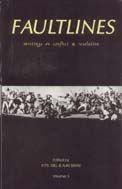
FAULTLINES: Volume I
Editor: K P S Gill
1999 ISSN 0972-1290
pp142
Price:
India: Rs 250
Abroad: $ 30
Buy
|
|
Faultlines focuses on various sources and aspects
of existing and emerging conflict in the Indian sub-continent.
Terrorism and low-intensity wars, communal, caste, and other sectarian
strife, political violence, organised crime, policing, the criminal
justice system and human rights constitute the central focus of
the journal.
|
|
|
FAULTLINES: Volume II
Editor: K P S Gill
1999 ISBN 81 87553 01 4
pp 179
Price:
India Rs 250
Abroad $ 30 Buy
|
|
Is the undeclared war in Kargil over, or has it
just begun? And within the context of the tides of violence that
constantly sweep across South Asia, was this a major crisis, or
just a minor skirmish? Faultlines takes an analytical look at
some of the new confrontations in the sub-continent, and at others
that have persisted for decades.
|
|
|
FAULTLINES: Volume III
Editor: K P S Gill
1999 ISBN 81 87553 02 2
pp181
Price:
India Rs 250
Abroad $ 30 Buy
|
|
General Parvez Musharraf's coup in Pakistan is
a clear indication that South Asia will remain an areas of instability
in the world, with its epicentre in India's volatile and irresponsible
neighbour. This makes the task of understanding existing and emerging
sources of strife in the region all the more
urgent.
|
|
|
FAULTLINES:VolumeIV
Editor: K P S Gill
1999 ISBN 81 7062 132 1
pp181
Price:
India Rs 250
Abroad $ 30 Buy
|
|
Had there been any illusion that the new millennium
would bring an age of peace and harmony to the Indian sub-continent,
these were dispelled both by the circumstances in which the last
year ended, and the way the new one began. Whatever little margine
for hope may have existed after the hijacking of IC-814 on Christmas
Eve last, it soon gave way to a series of devastating attacks
in Jammu & Kashmir on security forces' installations and personnel,
by the fidayeen and suicide squads of Pakistan-backed militants
and mercenaries. The sense of the collapse of the Indian State's
institutional response structures was reinforced again and again,
beginning with the handling of the hijack, through the humiliating
denouement at Kandahar on New Year Eve, down to each succeeding
attack on heavily guarded military, para-military and police camps
and establishments in J&K.
|
|
|
FAULTLINES: Volume V
Edited: K P S Gill
2000 ISBN 81-87553-04-9
pp 152
Price:
India: Rs 250
Abroad: $ 30 Buy
|
|
The past year has been one of both remarkable
successes against terroirsm in South Asia, and of considerable
and tragic failures. In Sri Lanka, even as the world's hopes of
a peaceful resolution rose with the prospects of mediation, critical
military reverses for the Government in the Jaffna peninsula inflicted
huge losses of life, and pushed the prospects of peace far into
an uncertain future. In India, it has been a traumatic time for
Kashmir, but significant gains havebeen registered in the Northeast.
Disturbing signs are emerging in Nepal, with escalating violence
by Maoist 'revolutionaries'.
|
|
|
FAULTLINES: Volume VI
Editor: K P S Gill
2000 ISBN 81-87553-05-7
pp148
Price:
India Rs 250
Abroad $ 30 Buy
|
|
Any permanent solution to the problem of terrorism
demands a clear understanding, not only of the immediate ground
situation and the proximate alignment of forces, but of the larger
context of each crisis and of teh imperatives of history. The
present volume explores the deeper linkages of a variety of conflicts
in the South Asian region.
|
|
|
FAULTLINES: Volume VII
Editor: K P S Gill
2000 ISBN 81 87553 06 5
pp 170
Price:
India Rs 250
Abroad $ 30 Buy
|
|
National perspectives on counter-terrorism are
proving increasingly inadequate in confronting the growing magnitude
and complexity of the threat of terrorism. The mobility and lethality
of terrorist groups has enormously augmented and there has been
an exponential increase in the support systems and contacts among
terrorist groups, transcending all conventional political boundaries.
The cross-border movement of populations compounds this problem
even further, as does the use of narcotics to underwrite the costs
of terrorism.
|
|
|
FAULTLINES: Volume VIII
Editor: K P S Gill
2000 ISBN 81 87553 07 3
pp 148
Price:
India Rs 250
Abroad $ 30 Buy
|
|
Terrorists combine extreme violence with a wide
range of overground political activity by front organisations
- public demonstrations, the adroit manipulation of the Press
and the Judicial process, and complex linkages with political
parties, 'human rights' groups and 'legitimate' businesses. This
volume explores the unique problems a democracy hasin dealing
with the collusive patterns through which terrorists exploits
the institutional structures and freedoms of the very system they
set out to destroy.
|
|
|
FAULTLINES: Volume IX
Editor: K P S Gill
2001 ISBN 81 87553 08 1
pp 160
Price:
India Rs 250
Abroad $ 30 Buy
|
|
The uncritical hysteria of expectations and the
almost delusional character of 'analyses' that dominates media
reportage on 'peace initiatives' pushes the ground realities of
internal conflicts into the far background. We thus have the repeated
experience of a comprehensive failure on the part of the political
establishment to accommodate the complex and destructive dynamic
of fragmented and unimaginative state responses confronting the
endless flexibility of constantly mutating terrorist organizations
and their supporters. This volume is an effort to restore a certain
measure of balance in the perspectives on various conflicts in
India that are arbitrarily and repeatedly destabilized by apparently
well-intentioned but ill-conceived policy initiatives
|
|
|
FAULTLINES: Volume X
Editor: K P S Gill
2002 ISBN 81 87553 09 X
pp 160
Price:
India Rs 250
Abroad $ 30 Buy
|
|
India's Northeast is an arena where a great tragedy
has been unfolding, as the original communities inhabiting the
region face a sustained assault as a result of the movement of
disadvantaged communities from contiguous areas, and of an unequal
confrontation with the processes of modernity. This volume brings
a special focus on the Northeast, exploring new perspectives on
the multiplicity of conflicts in the region, and assessing conventional
wisdom and past policies that have been applied to the resolution
of various problems there. It projects voices and perspectives
from the region to create a greater awareness of the divergences
in perception that exist in the discourse on insurgency and terrorism.
|
|
|
FAULTLINES: Volume XI
Editor: K P S Gill
2002 ISBN 81 87553 10 3
pp 152
Price:
India Rs 250
Abroad $ 30 Buy
|
|
Events since September 11, 2001, have inflicted
transformations on patterns of terrorism and counter-terrorism
that would have been inconceivable even days prior to the catastrophic
attacks in America. The present Volume turns a critical focus
on a wide range of conflicts, as well as initiatives for response
and resolution in the context of the post-9/11 era, reassessing
the past against the backdrop of emerging trends. Divergent perspectives
on terrorism, the insurgencies and peace processes in various
States in India's Northeast, current transformations in J&K, as
well as communal faultlines in the country, come under the uncompromising
scrutiny of experts drawn from a range of disciplines.
|
|
|
FAULTLINES: Volume XII
Editor: K P S Gill
2002 ISBN 81 87553 12 X
pp 176
Price:
India Rs 250
Abroad $ 30 Buy
|
|
There is a great churning in progress in South
Asia. Though the war on global terror continues in outward form,
its inner clarity and coherence of purpose have been diluted by
competing perceptions of geopolitical advantage. Thus, while Pakistan's
terrorist agenda is undergoing constant mutations under rising
international pressure, still it continues to evidence remarkable
continuities. This, indeed remains true of a multiplicity of terrorist
and insurgent movements in the region, which have been substantially
transformed by the pressures of the growing international consensus
against terrorist, but which nevertheless tend to concede no more
than what has been coerced. The war against terrorism clearly
promises to be a long one, and the present volume examines some
of its manifestations.
|
|
|
FAULTLINES: Volume XIII
Editor: K P S Gill
2002 ISBN 81 87553 13 8
pp 158
Price:
India Rs 250
Abroad $ 30 Buy
|
|
The 'Global War against Terror' notwithstanding,
the sources, the power and the impact of terrorism continue to
extend themselves into uncharted geographical areas. Though the
world today recognizes the imperatives of the containment of terrorist
violence, more than a year after 9/11, there is little evidence
of a consistent international resolve to do what is necessary
to secure this end. Counter-terrorism responses, both in South
Asia and in other theatres across the world, remain inchoate and
fitful. If the war against terrorism is to succeed, it will have
to evolve, before all else, a clearer understanding of the dynamics
of terrorism and the development of strategic perspectives that
can disrupt, and eventually neutralize, its support sytems. Faultlines
seeks to create the basis for such an understanding.
|
|
|
FAULTLINES: Volume XIV
Editor: K P S Gill
2003 ISBN 81 87553 14 6
pp 158
Price:
India Rs 250
Abroad $ 30 Buy
|
|
From crisis to crisis, the world has stumbled,
confounded, in its 'war against terror', with polices marked by
incoherence and damning contradictions. Meanwhile, the forces
of extremist violence and those who secure their inspiration from
the ideologies of hate are recovering from their brief disorientation
to consolidate their networks and resume operations. The opportunities
of the fleeting consensus that had crystallized in the wake of
the 9/11 attacks have largely dissipated. While a narrowly defined
group of terrorists - those that are seen to threaten the US -
are hunted relentlessly across the world, the pursuit of a 'false
peace' has become endemic among other victims of terrorism, as
democracies enter into unprincipled negotiations with terrorists,
mass murderers, and the rogue regimes that support and sponsor
them. Ambivalence, vacillation and error once again undermine
the international will to respond adequately to the gravity of
the challenge of terrorism.
|
|
|
FAULTLINES: Volume XV
Editor: K P S Gill
2004 ISBN 81-87553-15-4
pp 168
Price:
India Rs 250
Abroad $ 30 Buy
|
|
Is the enterprise of terrorism finally in a retreat?
In South Asia, at least, there are some indications that this
may be so. With the exception of the apparently indiscriminate
slaughters in Nepal since the breakdown of the 'peace process'
with the Maoist rebels in August 2003, fatality rates have registered
a decline in almost all theatres in the region.
But is this the prelude to a final winding down of terror, or
a tactical hibernation? Until conclusive evidence emerges to the
contrary, it is prudent to be sceptical, and to recognize the
possibility of a terrorist resurgence.
|
|
|
FAULTLINES: Volume XVI
Editor: K P S Gill
2005 ISBN 81-87553-16-2
pp 156
Price:
India Rs 250
Abroad $ 30 Buy
|
|
There appears to have been a secular decline in
trends in terrorist and insurgent violence in South Asia since
9/11, but there are dramatic skews in this trend, and there has
been a dramatic expansion in the geographical spread of such conflicts.
Worse, the spheres of political mismanagement and incompetence,
of general lawlessness and criminality, and of sectarian, communal
and other collective tensions appear to be expanding across much
of the region, notwithstanding isolated success stories and dramatic
economic and technological transformations in some areas.
The present volume is a small addition to the larger venture that
seeks to scrutinize the Byzantine patterns of terrorism and insurgency,
as well as the policies and practices to counter these.
|
|
|
FAULTLINES: Volume XVII
Editor: K P S Gill
2005 ISBN 81-87553-16-2
pp 156
Price:
India Rs 250
Abroad $ 30 Buy
|
|
It traces the history of the region, describes
the advent and growth of militancy, and enumerates the steps taken
to combat and control the insurgency situation. There is no single
model to combat insurgency. It has to be tailored to suit the
dangers and opportunities of the moment. The essential focus of
the situation in Kashmir has been towards the happenings in the
Kashmir valley. The spread of the problem into Doda and other
areas south of the Pir Panjal ranges has gone relatively unnoticed.
In the barren hillsides of Doda, the insurgency is more alarming
because it is in the hinterland. For the first time captured diaries
of militants are being published which give an insight into the
mind and motivation of those who take arms against the state.
|
|
|
FAULTLINES: Volume XVIII
Editor: K P S Gill
2005 ISBN 81-87553-16-2
pp 156
Price:
India Rs 250
Abroad $ 30 Buy
|
|
It traces the history of the region, describes
the advent and growth of militancy, and enumerates the steps taken
to combat and control the insurgency situation. There is no single
model to combat insurgency. It has to be tailored to suit the
dangers and opportunities of the moment. The essential focus of
the situation in Kashmir has been towards the happenings in the
Kashmir valley. The spread of the problem into Doda and other
areas south of the Pir Panjal ranges has gone relatively unnoticed.
In the barren hillsides of Doda, the insurgency is more alarming
because it is in the hinterland. For the first time captured diaries
of militants are being published which give an insight into the
mind and motivation of those who take arms against the state.
|
|
|
FAULTLINES: Volume XIX
Editor: K P S Gill
2005 ISBN 81-87553-16-2
pp 156
Price:
India Rs 250
Abroad $ 30 Buy
|
|
It traces the history of the region, describes
the advent and growth of militancy, and enumerates the steps taken
to combat and control the insurgency situation. There is no single
model to combat insurgency. It has to be tailored to suit the
dangers and opportunities of the moment. The essential focus of
the situation in Kashmir has been towards the happenings in the
Kashmir valley. The spread of the problem into Doda and other
areas south of the Pir Panjal ranges has gone relatively unnoticed.
In the barren hillsides of Doda, the insurgency is more alarming
because it is in the hinterland. For the first time captured diaries
of militants are being published which give an insight into the
mind and motivation of those who take arms against the state.
|
|
|
FAULTLINES: Volume XX
Editor: K P S Gill
2011 ISBN 81-87553-21-9
pp 170
Price:
India Rs 250
Abroad $ 30 Buy
|
|
|